
Gifted Students
Special Needs of Gifted Students
At Cook Vision Therapy Center, we consider it a privilege and delight to work with gifted students.
Too often, gifted children with frustrating vision problems manage to get “good grades,” but are often overlooked when it comes to the need for vision therapy. As parents, you should ask the question, “Is my gifted child performing at potential?”
Gifted students showcase exceptional intellectual abilities, yet their unique educational and emotional needs demand specialized support. While giftedness isn’t classified as a disability under laws like the Individuals with Disabilities Education Act (IDEA), these learners thrive with tailored instruction and enriched programs. Drawing insights from Reddit, Quora, and leading educational resources, this guide answers pressing questions from parents and educators. Explore actionable strategies to nurture gifted students’ cognitive growth, social skills, and emotional well-being—whether you’re a teacher, parent, or administrator.
What Are the Special Educational Needs of Gifted Students?
Understanding Giftedness as a Special Need
Gifted students process information faster and engage in complex problem-solving beyond their age group. They require customized curricula that challenge their creativity, critical thinking, and abstract reasoning. However, since giftedness isn’t recognized as a disability under IDEA, most only qualify for special education services if they’re twice-exceptional (2e) gifted with a co-occurring disability like ADHD or dyslexia.
Cognitive, Social, and Emotional Traits
-
Asynchronous Development: Intellectual abilities often outpace emotional or social maturity, leading to boredom, perfectionism, or isolation.
-
Key Support Strategies:
-
Flexible Learning: Accelerate beyond grade-level content.
-
Peer Collaboration: Group with intellectual equals to foster engagement.
-
Emotional Regulation: Teach coping mechanisms for anxiety or frustration.
-
Twice-Exceptional (2e) Students: Balancing Dual Needs
2e learners (e.g., gifted + autism) require comprehensive evaluations to address both strengths and challenges. Effective Individualized Education Programs (IEPs) must:
-
Provide advanced academic opportunities.
-
Integrate disability accommodations (e.g., extended time for dyslexic students).
-
Promote social-emotional growth through targeted interventions.
How to Identify & Support Gifted Students
Gifted Student Identification Process
Gifted students are identified through a multidisciplinary evaluation involving:
-
Cognitive testing (e.g., IQ tests like the WISC-V).
-
Teacher observations of advanced problem-solving or creativity.
-
Parent input on early developmental milestones and atypical traits.
-
A Gifted Multidisciplinary Team (GMDT) reviews data to create a Gifted Written Report (GWR), determining eligibility for services.
-
Twice-exceptional (2e) students require dual assessments to identify both giftedness and disabilities (e.g., ADHD, dyslexia).
Actionable Strategies to Support Gifted Students: Social, Emotional & Academic Growth
Foster Social Connections
-
Gifted Peer Groups: Enroll students in clubs like SENG (Supporting Emotional Needs of the Gifted) or Mensa for Kids to build relationships with intellectual equals.
-
Mentorship Programs: Pair learners with experts in their areas of interest (e.g., coding, robotics) for guided skill development.
Nurture Creativity & Critical Thinking
-
Project-Based Learning: Assign open-ended tasks (e.g., design a sustainable city) to challenge problem-solving skills.
-
Debates & Socratic Seminars: Encourage analytical discussions on ethics, science, or literature.
Address Perfectionism & Anxiety
-
Mindfulness Practices: Teach breathing exercises or yoga to manage stress.
-
Resilience Training: Normalize mistakes through activities like “Failure Fridays,” where students share and reflect on setbacks.
Optimize Academic Engagement
-
Flexible Pacing: Allow self-paced learning in core subjects like math or reading.
-
Tiered Assignments: Offer differentiated tasks (e.g., basic vs. advanced research projects) to match ability levels.
Collaborate with Professionals
-
School Counselors: Partner to create social-emotional learning (SEL) plans for coping with isolation or frustration.
-
Gifted Specialists: Advocate for professional development to help teachers recognize and nurture gifted traits.
Gifted children with eye-muscle coordination problems (see Convergence Insufficiency) compensate by learning to skim the material, leaving out or misreading words, but using intelligence to make sense out of what they have read.
Many gifted children have average eye-hand coordination, which is just not good enough. If “your mind travels at a hundred miles per hour while your hands are lucky to make the speed limit,” getting thoughts on the page is going to be a chore.
If your child is frustrated and not working to their potential, a vision evaluation is in order, no matter how good your child’s grades may be.
Free Internet Screening and Phone Consultation
If you or your child struggles with reading, call for a Free Phone Consultation. End the struggle!
FAQs
-
No, giftedness is not classified as a disability under federal laws like IDEA. However, some states/districts recognize gifted students as having special educational needs due to their need for tailored instruction. Twice-exceptional students (gifted + disability) qualify for special education services.
Check Out Our Resources
Dr. Cook’s Publications:
- Authored books VISUAL FITNESS and WHEN YOUR CHILD STRUGGLES.
- Published articles in top optometric journals.
- His article “Eyesight, infinity and the human heart” was voted “Best Non-Technical Article” by the Association of Optometric Editors.
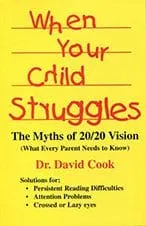
When Your Child Struggles

Visual Fitness
