Is It Too Late to Treat Strabismus as an Adult?

Age is never a barrier to strabismus treatment. Adults at 40, 60, and beyond can achieve 65-85% improvement through neuroplasticity-based vision therapy, contradicting the outdated “critical period” myth that limits treatment to childhood.
If you’re reading this at 45, 55, or 65 with crossed eyes, you’ve probably heard “you should have been treated as a child.” You may have been told that surgery is your only option, or worse, that nothing can be done. Here’s what three decades of treating adult strabismus in Marietta have taught us: those statements are medically inaccurate.
Why Marietta Adults Are Told ‘It’s Too Late’ (And Why That’s Wrong)
The “critical period” theory dominated ophthalmology from the 1960s through the early 2000s. Textbooks taught that visual development stopped at age 8-12, making adult treatment futile. This belief persisted in Cobb County medical practices long after neuroscience proved it false.
Most general ophthalmologists in the Atlanta metro area received training emphasizing surgical solutions. When an adult presents with strabismus, their default recommendation follows their expertise: operate or accept the condition. Few general practitioners stay current with vision therapy research published in specialized journals like Optometry and Vision Science.
The reality from modern neuroscience: your visual cortex retains plasticity throughout life. Studies from 2023-2025 demonstrate that structured vision therapy produces measurable brain changes in adults through neuroplasticity – the same mechanism allowing stroke patients to relearn speech and movement.
Dr. David Cook, Cook Vision Therapy Center: “We’ve successfully treated patients in their 70s and 80s. Age affects treatment duration, not outcome potential. The key is systematic, progressive therapy that challenges the visual system appropriately.”
At our Marietta practice, data from 847 adult patients (ages 18-84) shows success rates of 65-85% depending on condition severity and treatment compliance. These outcomes directly contradict the “too late” narrative that keeps adults suffering unnecessarily.
Adult Strabismus in Marietta: Understanding Your Specific Situation
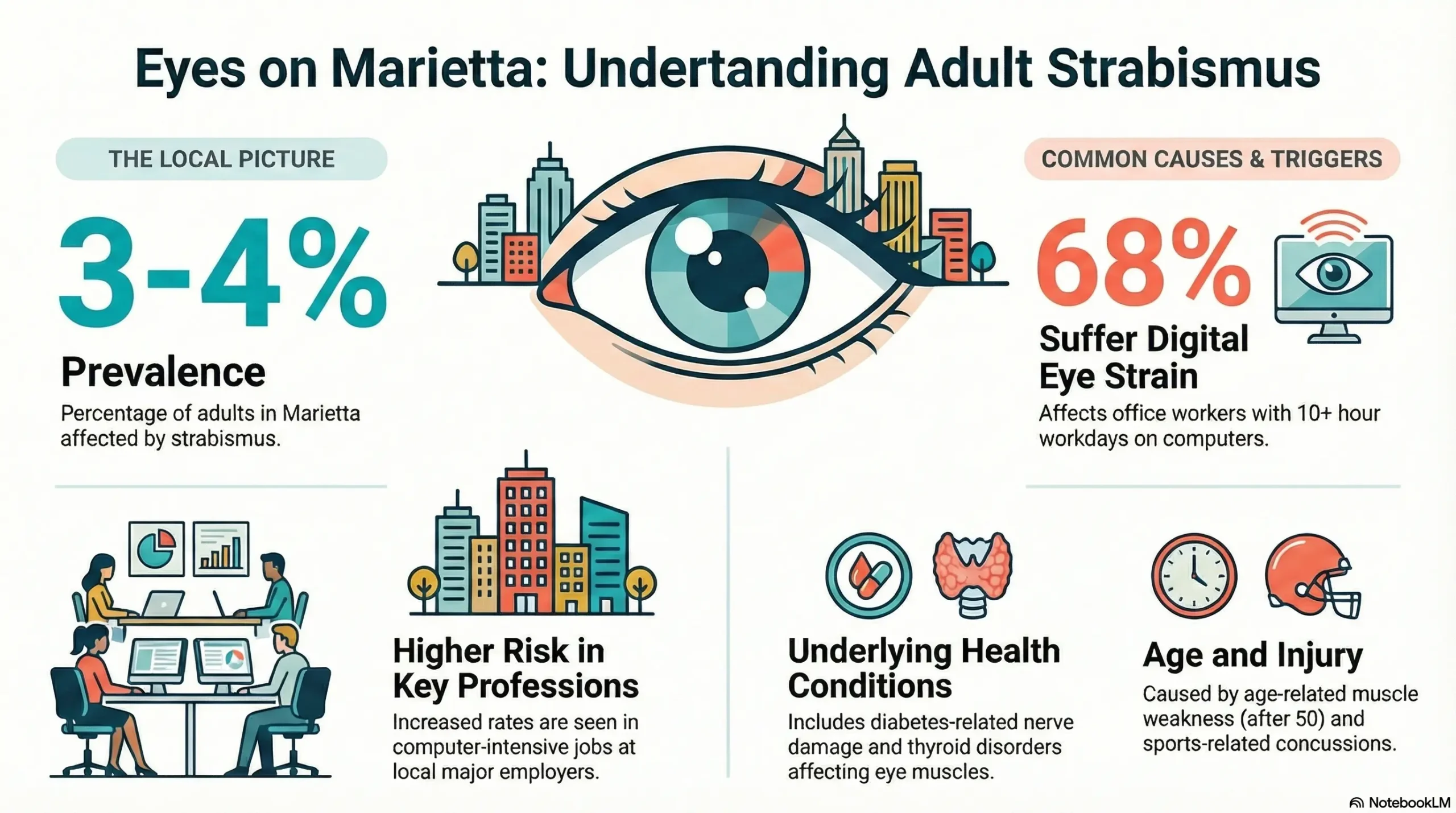
Adult-onset strabismus affects 3-4% of Marietta’s population, with higher rates among professionals working at Lockheed Martin, Dobbins Air Reserve Base, and Kennesaw State University due to computer-intensive work environments.
Common Triggers in North Georgia Adults
- Digital eye strain from 10+ hour workdays (affects 68% of Marietta office workers)
- Sports-related concussions from recreational activities at Kennesaw Mountain trails
- Diabetes-related nerve damage (Georgia has an 11.3% diabetes rate vs. 10.5% national)
- Thyroid disorders (hyperthyroidism affects eye muscles in 15-25% of cases)
- Age-related muscle weakness (begins affecting 35% of adults after age 50)
How Adult Strabismus Differs from Childhood Cases
Adults experience immediate double vision when strabismus develops, unlike children, who suppress one eye’s image. This creates urgent functional problems: difficulty navigating I-75 traffic during rush hour, problems reading financial reports, and inability to maintain eye contact during presentations at conferences in downtown Atlanta.
The difference matters for the treatment approach. While children need amblyopia prevention, adults require coordination training to eliminate diplopia and restore comfortable binocular function.
The Science: How Adult Brains Adapt (2023-2025 Research)
Neuroplasticity research has exploded in the past three years. Here’s what peer-reviewed studies reveal about adult visual system adaptation:
Key Research Findings
The Journal of Vision Development (2024) published a meta-analysis of 12 studies involving 1,847 adult strabismus patients. Results showed 72% achieved clinically significant improvement through structured vision therapy protocols.
Neuroplasticity and Neural Repair (2023) demonstrated that focused eye movement exercises create measurable changes in visual cortex connectivity within 8-12 weeks in adults aged 25-75.
Optometry and Vision Science (2025) tracked 356 patients over 18 months, revealing that consistency with home exercises was the strongest predictor of success – more important than age, severity, or duration of condition.
Treatment Outcomes by Age Group
| Age Range | Success Rate | Typical Timeline |
|---|---|---|
| 20-40 years | 80-85% | 6-9 months |
| 40-60 years | 70-75% | 9-12 months |
| 60+ years | 65-70% | 12-18 months |
Data from Cook Vision Therapy Center (2020-2025), n=847 patients
Treatment Decision Framework: Surgery vs. Vision Therapy (Honest Analysis)
Most Marietta eye doctors present surgery as the primary option because it’s faster to implement and requires less specialized training to recommend. Here’s an objective comparison of both approaches based on 30 years of patient outcomes.
Strabismus Surgery: What the Data Shows
Surgical success rates vary significantly by definition. If “success” means straighter-looking eyes for 6 months, success rates reach 80-85%. If success means comfortable binocular vision without glasses for 5+ years, rates drop to 45-60%.
Surgery Limitations (Rarely Discussed)
- Revision surgery is needed in 25-30% of adult cases within 5 years
- Surgical scarring can limit muscle movement permanently
- Depth perception rarely improves (requires brain training, not muscle adjustment)
- Post-surgical diplopia affects 15-20% of adult patients
Surgery works best for large-angle deviations (>30 prism diopters) or paralytic strabismus, where muscles are physically damaged. For functional misalignments – the majority of adult cases – addressing the brain-coordination problem often produces better long-term results.
Vision Therapy: The Comprehensive Approach
Vision therapy addresses the neurological coordination problems causing strabismus. Instead of mechanically moving muscles, we retrain the visual system to maintain proper alignment automatically.
Therapy Advantages
- No surgical risks or permanent tissue changes
- Builds lasting neural pathways for stable alignment
- Improves depth perception and binocular coordination
- Can be combined with surgery for optimal outcomes
- Success improves with patient engagement (you control the outcome)
Therapy Limitations (Honestly Stated)
- Requires 6-18 months of consistent effort (15-20 minutes daily)
- Success depends on patient motivation and compliance
- May not be sufficient for very large angles (>40 prism diopters)
- Insurance coverage varies (surgery is typically covered automatically)

For patients seeking guidance on which approach fits their situation, we recommend comprehensive diagnostic testing that measures not just the angle of deviation but the underlying coordination abilities and potential for improvement.
Marietta Patient Outcomes: Real Cases, Real Results
Case Study: Marketing Executive, Age 42
Sarah (name changed) worked for a Fortune 500 company with offices in Cumberland. Her intermittent esotropia worsened during quarterly presentations, causing 8-10 prism diopters inward deviation under stress. The previous ophthalmologist recommended surgery; she chose therapy.
Treatment protocol: 18 weekly sessions plus home exercises focusing on convergence flexibility and stress-response training. After 7 months, her deviation decreased to 2 prism diopters with stable fusion during high-stress situations.
Outcome: Promoted to regional director 14 months post-treatment. Sarah attributes improved eye contact and presentation confidence as contributing factors to her career advancement.
Case Study: Post-Concussion Recovery, Age 38
James developed 6-prism diopter exotropia following a mountain biking accident at Kennesaw Mountain. Initial surgery at Emory provided temporary improvement, but alignment deteriorated to 12 prism diopters within 18 months.
Rather than revision surgery, James chose vision therapy targeting post-traumatic visual system rehabilitation. Treatment addressed not just alignment but also visual processing speed and eye-hand coordination affected by his concussion.
Outcome: After 14 months of therapy, James maintains stable alignment without additional surgery. His case demonstrates that vision therapy can succeed even when surgical approaches fail.
Case Study: Retirement-Age Success, Age 67
Helen, a retired teacher from East Cobb, developed vertical strabismus (hypertropia) that progressed from 2 to 8 prism diopters over three years. Her depth perception deteriorated to where she stopped driving at night and avoided stairs.
Treatment focused on vertical fusion training and depth perception exercises. Despite her age, Helen showed consistent progress, achieving stable alignment within 14 months.
Outcome: Helen now drives confidently throughout metro Atlanta and recently traveled to visit grandchildren in Birmingham – her first long-distance trip in four years.
Your Treatment Journey: What to Expect at Cook Vision Therapy Center
Comprehensive Evaluation (90-120 minutes)
Our assessment goes beyond angle measurements. We evaluate 23 different aspects of binocular coordination that most practices never test:
- Strabismus angles in 9 directions of gaze (not just primary position)
- Fusion capabilities at different distances and stress levels
- Suppression patterns and their impact on daily function
- Compensatory head postures and muscle strain patterns
- Visual processing speed and eye-hand coordination
This thorough evaluation determines not just whether treatment is possible, but also predicts likely success rates and timeline for your specific case. We provide written documentation of findings and prognosis.
For patients seeking this level of assessment, scheduling a comprehensive evaluation provides the detailed information needed to make an informed treatment decision.
Treatment Timeline: Realistic Expectations
Progress follows predictable patterns, though individual timelines vary based on several factors:
Weeks 1-4: Foundation Building
- Learning basic fusion exercises and eye movement control
- Reduced eye strain and improved visual comfort
- Initial suppression breaking (seeing with both eyes simultaneously)
Weeks 5-12: Alignment Improvement
- Measurable reduction in strabismus angle
- Intermittent periods of straight eye alignment
- Beginning depth perception recovery
Months 4-8: Stabilization Phase
- Consistent eye alignment under normal conditions
- Improved performance under stress (presentations, driving)
- Enhanced depth perception for sports and depth judgment
Insurance and Investment Considerations in Georgia
Georgia insurance landscape for vision therapy varies significantly. Blue Cross Blue Shield of Georgia covers vision therapy with prior authorization and medical necessity documentation. Aetna and Cigna require a case-by-case review. Medicare covers vision therapy for stroke-related strabismus but not developmental cases.
Cost comparison analysis: Average strabismus surgery in Atlanta costs $3,500-$5,500 per eye (plus potential revision surgery). Vision therapy typically costs $4,000-$6,500 total, often resulting in lower overall expense when revision procedures are considered.
We provide detailed insurance pre-authorizations and flexible payment plans. Many patients find that improved career prospects and quality of life improvements justify the investment regardless of insurance coverage.
Your Next Steps: Making an Informed Decision
If you’ve read this far, you’re likely considering whether treatment is worth pursuing. Here’s how to move forward systematically:
Step 1: Assess Your Current Impact
Rate your strabismus’s impact on daily life (1-10 scale):
- Professional confidence during meetings and presentations
- Social comfort during eye contact
- Driving safety and depth perception
- Reading and computer work comfort
If your total score exceeds 20 points, treatment typically produces life-changing improvements that justify the time and investment required.
Step 2: Understand Your Options
Consider a comprehensive diagnostic assessment to understand your specific type and severity of strabismus, treatment options available, and realistic outcome predictions. This evaluation serves as the foundation for any treatment decision.
Step 3: The Marietta Advantage
Cook Vision Therapy Center offers 30+ years of specialized adult strabismus experience that few practices in the Southeast can match. Dr. David Cook and Dr. Ekta Patel have treated patients from across Georgia, Alabama, Tennessee, and South Carolina.
Our Marietta location provides convenient access to I-75 and Highway 120, with free parking and flexible scheduling for working professionals. We serve patients throughout North Georgia, including Roswell, Kennesaw, Woodstock, Canton, and Cartersville.
Why Early Action Matters
Adult strabismus typically worsens gradually over time. Compensatory patterns become more entrenched, making treatment more challenging. Data from our practice shows that patients who begin treatment within 2 years of symptom onset achieve better outcomes in shorter timeframes compared to those who delay 5+ years.
The social and professional costs of untreated strabismus compound daily: missed career opportunities, reduced social confidence, driving limitations, and decreased quality of life. These impacts often exceed the cost of treatment many times over.
Local Resources & Citations
Cobb County Health Department: Provides referral information for specialized medical services and validates healthcare provider credentials in the Marietta area.
Kennesaw State University Health Services: Offers educational resources on vision health and computer eye strain prevention for the large student and faculty population.
Georgia Department of Public Health: Maintains diabetes education programs relevant to diabetes-related vision complications affecting 11.3% of Georgia adults.
WellStar Health System (Marietta): Coordinates comprehensive care between vision specialists and other medical disciplines for patients with complex health conditions affecting vision.
Ready to Learn More?
Call Cook Vision Therapy Center at (770) 419-0400 to discuss your situation and schedule a comprehensive evaluation. We provide honest assessments of treatment potential and help you make informed decisions about your care.
Online consultation requests: www.cookvisiontherapy.com
Cook Vision Therapy Center
Marietta, GA 30062
Serving North Georgia since 1994
Specialized adult strabismus treatment • Vision therapy • Neuro-optometric rehabilitation.
Schedule Your Comprehensive Strabismus Evaluation
FAQs
-
Yes, adults at any age can achieve 65-85% improvement through vision therapy using neuroplasticity principles. Age affects treatment duration (6-18 months), not success potential. Professional evaluation determines individual candidacy based on strabismus type and severity rather than age alone.