Home Vision Therapy: Does It Actually Work?

Imagine your child comes home from school frustrated again — homework that should take 20 minutes stretches into an hour. Or maybe you’ve been dealing with headaches after screen time for months, and every eye exam comes back “normal.” You’ve heard about vision therapy, and then you wonder: Do I really need to go to a clinic, or can I just look up some exercises and do this at home?
It’s a fair question. And you deserve a straight answer — not a sales pitch.
Here it is: Some vision exercises can be done at home, but home exercises alone are not the same as vision therapy. The difference matters more than most people realize, and understanding it could save you months of frustration and help you make the right call for yourself or your child.
What “Home Vision Therapy” Actually Means — And What It Doesn’t
Home vision exercises are real. Techniques like pencil push-ups, the Brock string, near-far focus shifts, and barrel card training have been used for decades. They are legitimate tools that train eye coordination and focusing ability. You can find instructions for them online, and they are genuinely useful — when used correctly, for the right condition, at the right stage of treatment.
That last part is the piece most people skip.
These exercises are components of a vision therapy program, not a program in themselves. Doing pencil push-ups without a diagnosis is a little like following a physical therapy routine you found on YouTube after an injury you haven’t had examined. You might stumble onto something helpful, or you might reinforce a compensating pattern that makes the underlying problem harder to treat later.
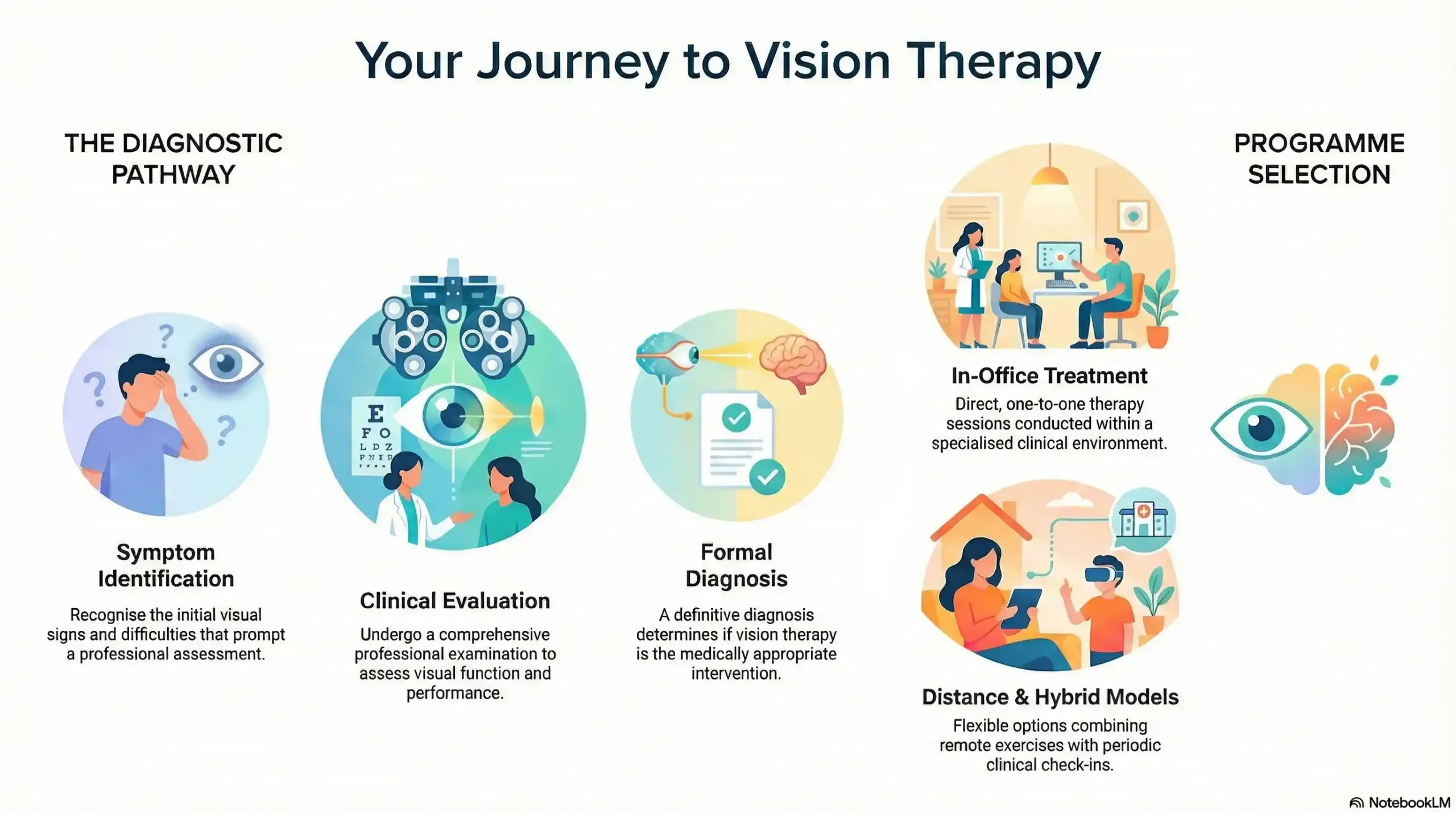
A proper vision therapy program begins with a comprehensive evaluation — one that goes well beyond the standard 20/20 eye chart. It assesses binocular vision, eye teaming, tracking, convergence, focusing stamina, visual processing, and in cases like post-concussion rehabilitation, the neurological pathways that coordinate all of it. That evaluation is what determines which exercises are appropriate, in what order, at what intensity, and for how long.
Without that foundation, you’re working blind — so to speak.
What the Research Actually Says About Home-Only Exercises
This isn’t just clinical opinion. The evidence is clear, and it points in one direction.
The Convergence Insufficiency Treatment Trial (CITT), a landmark multi-center randomized clinical trial funded by the National Eye Institute, studied 221 children aged 9 to 17 with symptomatic convergence insufficiency — one of the most common vision problems affecting reading and learning. Participants were divided into four groups: office-based therapy with home reinforcement, home-based pencil push-ups, home-based computer therapy, and office-based placebo.
The results were striking. A major clinical trial from the National Eye Institute found 75% of kids with convergence insufficiency became symptom-free after completing in-office therapy with home practice. In contrast, only 43% of children prescribed home pencil push-ups improved, which was no better than placebo.
Read that again: pencil push-ups performed no better than a placebo treatment. And those weren’t children doing random exercises — they were following prescribed, structured home routines. The problem wasn’t effort or consistency. The problem was the absence of clinical supervision, progressive adaptation, and specialized equipment.
Comparative studies reveal that intensive in-office therapy consistently outperforms minimally intensive home programs, emphasizing that structured, supervised treatment leads to better outcomes for those with convergence insufficiency.
For families in Marietta and across Metro Atlanta who have already tried generic exercises without results, this research explains why.
Not sure yet? That’s completely fine. If you’d like to understand more about a specific condition — whether it’s your child’s reading struggles, your own post-screen headaches, or recovery after a concussion — reach out and describe what you’re experiencing. The team will point you in the right direction.
The Supervision Gap: Why It Changes Everything
Think about the difference between exercising on your own and working with a skilled physical therapist after a knee injury. Both involve movement. But the therapist watches how you compensate, adjusts the resistance, catches the moment you’re reinforcing a bad pattern, and knows when to progress you to the next stage. That feedback loop is where most of the therapeutic value lives.
Vision therapy works the same way.
Specialized equipment — such as prisms, computerized visual activities, and interactive tools — is often used in-office to help train the eyes and brain to work together more effectively. These tools are not typically available for home use, which can limit the effectiveness of a self-guided program.
At Cook Vision Therapy Center in Marietta, Dr. David Cook and Dr. Ekta Patel use instrumentation during in-office sessions that cannot be replicated at home — therapeutic lenses, prisms, and tools like Vivid Vision, a clinically validated virtual reality platform used by prescription for specific conditions. Between sessions, patients do receive prescribed home exercises as part of their program. But those home exercises are the reinforcement, not the treatment itself.
The clinical visit is where the therapist observes exactly how both eyes are performing under demand, identifies where compensation or suppression is occurring, and adjusts the program accordingly. That adaptive precision is what produces lasting change — not just temporary symptom relief.
Conditions That Require Clinical Supervision — Not DIY Solutions
Some vision conditions carry real risk if addressed without proper diagnosis and oversight. Here are the situations where attempting home-only therapy isn’t just ineffective — it can delay appropriate care:
Strabismus (Crossed or Turned Eye): Eye misalignment needs precise evaluation to determine whether the turn is constant or intermittent, which eye is suppressing, and how the brain has adapted. Unsupervised exercises cannot address suppression, and in some cases can worsen binocular confusion.
Amblyopia (Lazy Eye): Patching without clinical guidance can cause over-patching, which may temporarily reduce vision in the stronger eye. Modern evidence shows that shorter, targeted sessions combined with active therapy produce better long-term outcomes than prolonged unsupervised patching.
Post-Concussion Vision Problems: Double vision, light sensitivity, dizziness, and visual fatigue following a traumatic brain injury or concussion are neurological in nature. These require neuro-optometric rehabilitation — a specialized field that integrates vision and neurological recovery. Generic home exercises are not designed for this and will not address the underlying dysfunction.
Visual Processing Disorders: If a child struggles with reading despite adequate eyesight, the problem may lie in how the brain interprets what the eyes see. This requires specific diagnostic testing and a program designed around the child’s neurological profile, not a one-size-fits-all exercise routine.
For all of these conditions, the first step is an evaluation — not a YouTube tutorial.
If you’re ready to move forward, scheduling a comprehensive vision therapy evaluation is the most direct route to answers.
So, Where Do Home Exercises Fit In?
Home exercises are a legitimate and important part of a well-designed vision therapy program. Done correctly, they reinforce what is learned during in-office sessions, accelerate progress, and help new visual skills become automatic rather than effortful.
The key phrase is “done correctly.” Patients at Cook Vision Therapy receive specific home assignments tailored to their current stage of therapy — not generic exercises, but targeted activities prescribed by Dr. Cook or Dr. Patel based on what was observed in that week’s session.
A common pattern: a patient makes slow progress with in-office sessions alone. Once they commit to consistent daily home exercises between visits, progress accelerates significantly. The home work and the clinical sessions aren’t competing approaches — they’re partners.
This is the model that the CITT and subsequent research consistently validate: office-based therapy with home reinforcement produces the best outcomes. Neither component alone is as effective as both together.

What a Proper Evaluation Looks Like in Marietta, GA
If you’ve been wondering whether vision therapy is the right path, the place to start is a comprehensive vision therapy evaluation — not a standard eye exam, which typically checks only acuity and eye health.
At Cook Vision Therapy Center in Marietta, a full evaluation assesses visual acuity, binocular vision, eye movement control, convergence, focusing ability, depth perception, and visual processing. For post-concussion patients, additional neuro-optometric assessments are included. The results determine whether vision therapy is appropriate, what the program should look like, and what outcomes are realistic.
Dr. David Cook has over 40 years of experience in vision therapy and neuro-optometric rehabilitation. Dr. Ekta Patel brings more than 15 years of clinical experience serving Georgia families. Together, they have helped thousands of patients across Metro Atlanta — from children struggling in school in Kennesaw and Roswell, to adults managing double vision after neurological events, to patients who travel from across the Southeast specifically for their expertise.
The practice also offers personalized distance therapy programs for patients who cannot travel regularly, following an initial in-person evaluation. Structure and supervision are maintained even for patients who cannot be present weekly.
Local Resources & References
National Eye Institute (NEI): The federal body that funded the landmark Convergence Insufficiency Treatment Trial (CITT). Their research database provides peer-reviewed studies on vision therapy outcomes for conditions including convergence insufficiency and amblyopia.
PubMed / National Library of Medicine: Searchable database of peer-reviewed clinical research, including all published CITT studies, neuro-optometric rehabilitation evidence, and binocular vision treatment trials.
Georgia Department of Education: Guides vision screening requirements for Georgia schoolchildren, IEP accommodations for vision-related learning difficulties, and referral protocols for functional vision evaluations.
Brain Injury Association of Georgia: Georgia’s state affiliate for brain injury support and rehabilitation resources, relevant for patients seeking neuro-optometric rehabilitation following traumatic brain injury or concussion in the Metro Atlanta area.
Is It Time for an Evaluation?
If you’ve been managing symptoms — or watching your child manage them — and wondering whether something more could be done, this is the right moment to find out.
A free phone consultation with Cook Vision Therapy Center in Marietta takes 10 to 15 minutes and is designed to help you understand whether a full evaluation makes sense for your situation. There’s no obligation, no pressure, and no guesswork. You’ll leave the call knowing whether vision therapy is a realistic path forward and what the next step looks like.
Frequently Asked Questions
-
You can perform maintenance exercises at home, but initial therapy requires professional diagnosis. Self-treating without a doctor’s plan risks worsening eye strain or causing permanent double vision