Online Vision Games & Lazy Eye: Are They Safe? | Marietta, GA
📌 Direct Answer
Online vision games designed for lazy eye — also called amblyopia — can offer some benefit, but they are not inherently safe or effective without professional supervision. While certain digital therapy tools use evidence-based dichoptic techniques that may support amblyopia treatment, they are not a substitute for a comprehensive, clinician-directed vision therapy program. The safest and most effective approach always begins with a professional vision therapy evaluation to identify the root cause of your child’s condition. For families in Marietta, GA and Metro Atlanta, Cook Vision Therapy Center offers expert pediatric amblyopia treatment — including a patching-free option — guided by Dr. David L. Cook, O.D., F.A.A.O., F.C.O.V.D., with over 40 years of clinical experience.
What Is Lazy Eye (Amblyopia) and Why Does It Affect How Children See?
If your child has been diagnosed with lazy eye, you already know that the name can be misleading. Amblyopia is not simply a matter of one eye being “lazy.” It is a complex neurodevelopmental condition in which the brain, during a child’s critical visual development window, begins to favor one eye over the other — suppressing the visual signal from the weaker eye. Over time, this suppression becomes deeply ingrained, reducing visual acuity in the affected eye even when that eye is structurally healthy.
For parents in Marietta, Kennesaw, Roswell, and across Cobb County, understanding this distinction is crucial. Amblyopia is a brain-based vision problem — not simply an eye problem — and that distinction changes everything about how it should be treated.
How the Brain and Eyes Work Together in Amblyopia
In a child with healthy binocular vision, both eyes send clear, coordinated signals to the brain, which fuses them into a single, three-dimensional image. In amblyopia, this teamwork breaks down. The brain begins to ignore or suppress the signal from the weaker eye, and without intervention during the critical developmental window — typically before age 12, though treatment can be effective in older children and adults — the suppression can become permanent.
This is why the stakes are high, and why the treatment approach matters so deeply.
Why Standard Eye Exams Often Miss the Full Picture
One of the most important things parents should understand is that a standard school vision screening or routine eye exam is not designed to detect amblyopia in its full complexity. These screenings measure visual acuity — how clearly each eye sees a chart — but they do not evaluate how the eyes work together, how the brain processes visual information, or whether suppression is occurring. A child can pass a standard eye exam and still have a significant binocular vision disorder driving their lazy eye.
This is precisely why a comprehensive Vision Therapy Evaluation — performed by a specialist like Dr. David L. Cook at our Marietta, GA clinic — is the essential first step for any child with a suspected or diagnosed amblyopia condition.
What Are Online Vision Games for Lazy Eye — and How Do They Work?
In recent years, a new category of digital tools has emerged that promises to treat amblyopia through interactive games and screen-based activities. As a parent, you may have encountered names like Amblyoplay, Luminopia, or similar products through a Google search, a parenting group, or even a recommendation from another family. Your curiosity is completely understandable — and your instinct to research before acting is exactly right.
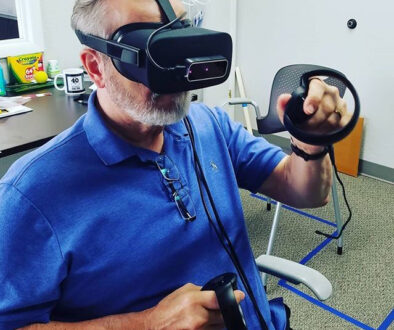
These tools are typically built on a concept called dichoptic therapy, a legitimate and research-supported approach in which different images are presented to each eye simultaneously, forcing the brain to use both eyes together and gradually reducing suppression of the weaker eye.
The Science Behind Dichoptic Therapy and Digital Vision Training
The underlying science of dichoptic therapy is real and has been studied in peer-reviewed clinical research. When delivered correctly — with the right contrast ratios, appropriate session duration, and proper calibration for each child’s specific level of suppression — dichoptic approaches can contribute meaningfully to amblyopia treatment. This is not pseudoscience. It is a legitimate therapeutic modality.
The critical question, however, is not whether the science is valid. The critical question is whether an unsupervised, commercially available app can deliver that science safely and effectively for your specific child.
Popular Examples Parents Are Searching For
Several products are widely marketed to parents as home-based amblyopia solutions. While we do not dismiss these tools categorically, any digital vision therapy must be evaluated and integrated by a qualified vision therapy specialist — not used independently as a standalone treatment without professional oversight.
📞 Not sure if your child’s lazy eye has been properly diagnosed? Call Cook Vision Therapy Center at (770) 419-0400 for a Free Phone Consultation — no pressure, just honest answers from our expert team in Marietta, GA.
The Real Safety Question — What the Research Actually Says
Here is where we must be honest with you, because you deserve a straight answer from a clinical perspective — not a commercially motivated one.
The research on home-based, unsupervised digital vision games for amblyopia shows a nuanced picture. Some studies, including work supported by the National Eye Institute’s Pediatric Eye Disease Investigator Group (PEDIG), have explored dichoptic game-based therapy with encouraging preliminary results. However, the same body of research consistently reinforces one conclusion: outcomes are significantly better when digital tools are used as part of a supervised, comprehensive vision therapy program — not as a replacement for it.
What Studies Show About Supervised Digital Therapy for Amblyopia
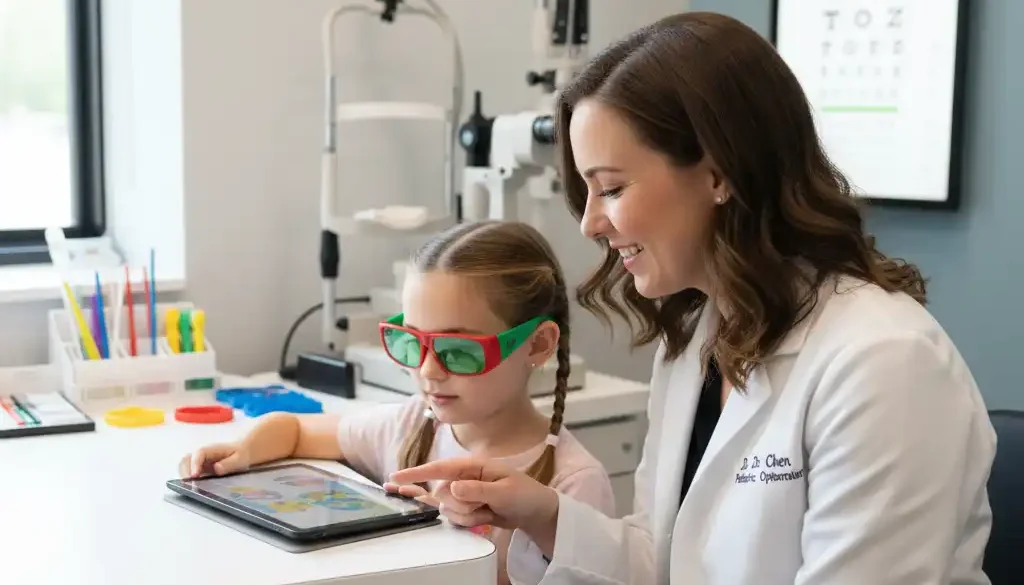
When dichoptic games are prescribed, calibrated, and monitored by a qualified clinician, they can serve as a valuable and engaging complement to in-office vision therapy — particularly for children who respond well to interactive formats. Progress is tracked, dosage is adjusted, and the treatment evolves as the child’s visual system responds.
The Risks Parents Are Not Being Told About Unsupervised Vision Games
When the same tools are used without supervision, several significant risks emerge that app marketing materials rarely disclose.
Incorrect dosage is perhaps the most common and most consequential risk. Each child’s amblyopia exists on a spectrum of severity, and the appropriate contrast level, session duration, and visual demand must be calibrated to that specific child. An app cannot do this. Using too-high contrast or too-long sessions can actually reinforce suppression rather than reduce it.
Delayed diagnosis of underlying conditions is another serious concern. Amblyopia is often associated with other binocular vision disorders — convergence insufficiency, strabismus, or accommodative dysfunction — that require separate clinical attention. A parent using an app at home may believe the condition is being treated while a co-existing disorder goes undetected and worsens.
False reassurance may be the most emotionally difficult risk to discuss. We understand how much hope a parent invests in a solution that seems to be working. But without clinical benchmarks and professional progress monitoring, there is no reliable way to know whether your child’s visual system is genuinely improving — or whether deeper intervention is being delayed during a critical developmental window.
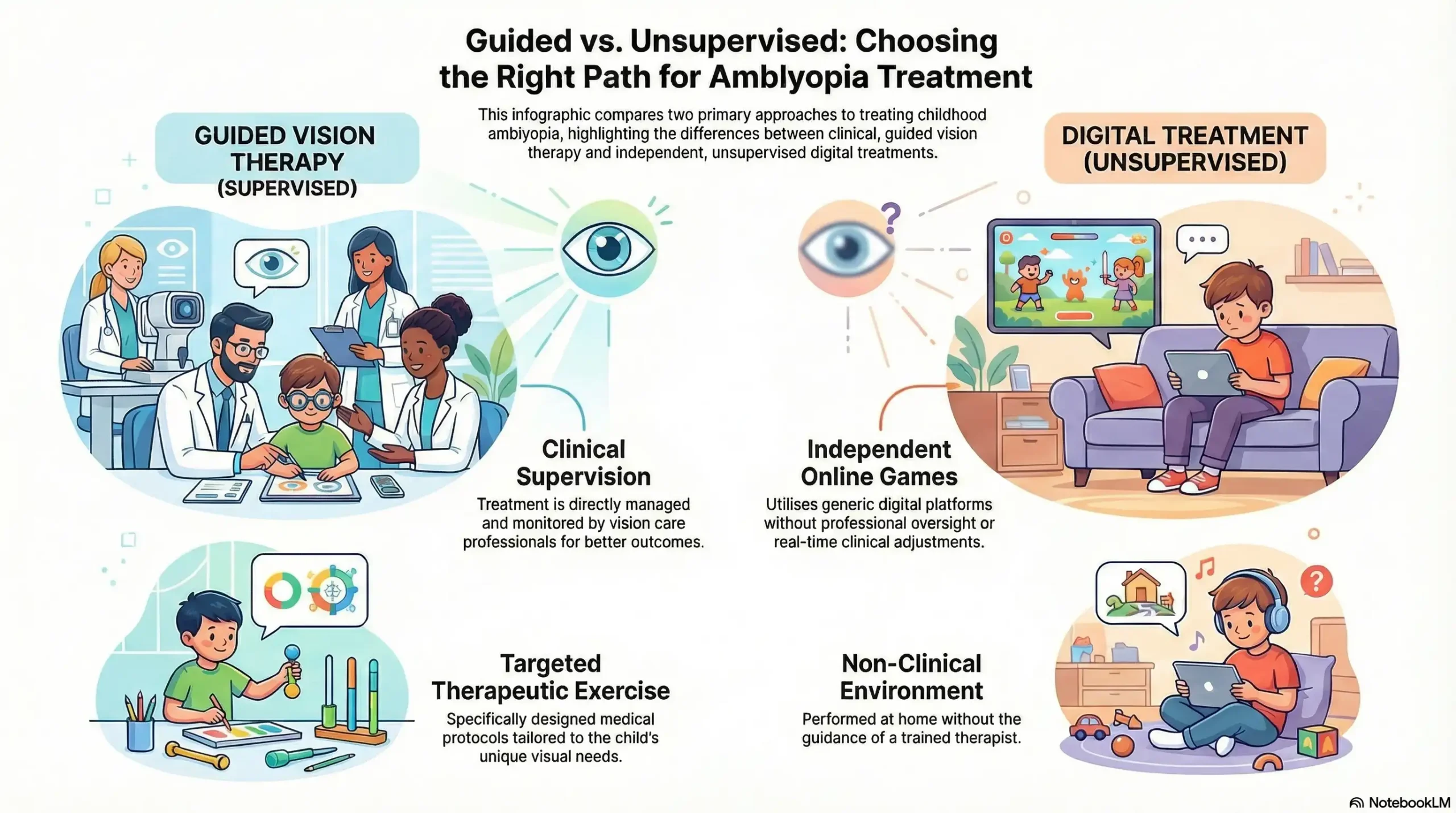
| Factor | Supervised Vision Therapy | Unsupervised Online Games |
|---|---|---|
| Professional Oversight | ✅ Yes — by F.C.O.V.D.-certified doctor | ❌ None |
| Customized to Child | ✅ Fully personalized program | ❌ Generic, one-size-fits-all |
| Addresses Root Cause | ✅ Diagnoses & treats underlying condition | ❌ Targets symptoms only |
| Progress Monitoring | ✅ Ongoing clinical evaluation | ❌ No clinical benchmarks |
| Safe Screen Dosage | ✅ Medically appropriate duration | ❌ No dosage control |
| Patching-Free Option | ✅ Available at Cook Vision Therapy | ❌ Not applicable |
| Suitable Age Range | ✅ Children & adults, all ages | ⚠️ Varies by product |
| Long-Term Results | ✅ Evidence-based lasting outcomes | ⚠️ Limited long-term clinical evidence |
5 Critical Factors That Determine Whether a Vision Game Is Safe for Your Child
If your child has been diagnosed with amblyopia and you are considering any digital vision tool — whether on its own or alongside professional therapy — these are the five factors that a qualified vision therapy specialist will evaluate before making any recommendation.
Factor 1 — Professional Diagnosis Must Come First
No digital tool, however sophisticated, can substitute for a comprehensive clinical evaluation. Before any game-based therapy is introduced, your child’s specific type and severity of amblyopia must be diagnosed, along with any co-existing binocular vision conditions. At Cook Vision Therapy Center, our Vision Therapy Evaluation provides exactly this foundation — a clear, complete picture of your child’s visual system and a personalized roadmap for treatment.
Factor 2 — Age and Developmental Stage of the Child
The visual system is most neuroplastic — most responsive to treatment — during the early developmental years. While amblyopia can be treated successfully in older children and even adults, the urgency of early intervention is real. The appropriateness of any digital therapy tool must be matched to your child’s age, attention span, and stage of visual development.
Factor 3 — Screen Time Dosage and Session Length
For a child already navigating a world of screens — school devices, tablets, and smartphones — adding unsupervised screen-based vision therapy introduces a real risk of visual fatigue and overexposure. A clinician will prescribe appropriate session lengths and ensure that digital therapy tools complement — rather than compound — your child’s total daily screen burden.
Factor 4 — Whether the Game Targets Binocular Vision or Not
Not all vision games are created equal. Some apps target monocular acuity — training the weaker eye in isolation — while more advanced dichoptic tools target binocular vision, training both eyes to work together. For true amblyopia treatment, binocular engagement is essential. A qualified specialist will evaluate whether any given tool is genuinely targeting the right visual function for your child’s specific condition.
Factor 5 — Integration With a Supervised Therapy Program
The most effective use of digital vision tools for amblyopia is as a structured component of a broader, supervised vision therapy program — not as a standalone solution. When prescribed as at-home reinforcement between in-office sessions, these tools can accelerate progress and keep children engaged. Without that clinical framework, their benefit is uncertain and their risk is real.
Can Online Vision Games Replace Professional Vision Therapy for Lazy Eye?
This is the question at the heart of every parent’s research — and it deserves a direct, honest answer.
What Online Games Can Do Well
When properly prescribed, calibrated digital vision tools can increase treatment engagement for children who respond well to interactive formats. They can reinforce skills developed in supervised therapy sessions, extend the therapeutic benefit between clinic visits, and make the treatment process feel less clinical and more enjoyable for young patients. These are real and meaningful benefits.
What Only a Supervised Vision Therapy Program Can Achieve
A comprehensive, supervised vision therapy program addresses the full complexity of amblyopia in a way no app can replicate. It diagnoses and treats co-existing binocular vision disorders. It monitors progress against clinical benchmarks, adjusts the treatment as the visual system responds, and provides the professional accountability that lasting outcomes require. It also addresses the deeper neurological dimension of amblyopia — retraining the brain’s visual processing pathways, not just the eye.
The Patching-Free Alternative Most Parents Don’t Know About
One of the most significant limitations of many home-based approaches — including traditional patching — is that they can be uncomfortable, socially difficult, and emotionally hard on children. At Cook Vision Therapy Center, we offer a patching-free amblyopia treatment program that uses advanced vision therapy techniques to achieve the same goal — strengthening the weaker eye and restoring binocular vision — without the social and emotional burden of an eye patch. For many families, this is a life-changing discovery.
🗓️ At Cook Vision Therapy Center in Marietta, GA, we offer a patching-free amblyopia treatment program personalized for your child’s unique visual profile. Call us at (770) 419-0400 or visit cookvisiontherapy.com to schedule your child’s Vision Therapy Evaluation today.
What a Safe, Supervised Lazy Eye Treatment Program Looks Like in Marietta, GA
For families across Metro Atlanta — in Marietta, Kennesaw, Roswell, and Cobb County — Cook Vision Therapy Center represents something rare: a specialized clinical practice where world-class expertise meets genuine, patient-centered compassion.
Meet Dr. David L. Cook — Over 40 Years Treating Amblyopia in Metro Atlanta
Dr. David L. Cook, O.D., F.A.A.O., F.C.O.V.D. is an internationally recognized clinician, author, and educator with over four decades of experience in vision therapy and visual rehabilitation. He is the author of Visual Fitness and When Your Child Struggles — two landmark resources that have guided thousands of families through the vision therapy journey. His credentials — Fellow of the American Academy of Optometry and Fellow of the College of Optometrists in Vision Development — represent the highest standard of specialized expertise in this field.
Dr. Cook’s approach is rooted in a simple but powerful conviction: every patient deserves to understand exactly how vision is affecting their life, and every treatment plan should be as unique as the patient receiving it.
How Cook Vision Therapy Center’s Personalized Approach Works
Treatment at Cook Vision Therapy Center begins with a comprehensive Vision Therapy Evaluation — a thorough diagnostic process that goes far beyond a standard eye exam. This evaluation identifies the specific type and severity of amblyopia, uncovers any co-existing binocular vision conditions, and forms the foundation of a fully personalized therapy plan.
From there, patients engage in a structured program combining in-office vision therapy sessions with essential at-home exercises — a collaborative model that patients and families describe as transformative. As one patient’s family noted, success in vision therapy is a partnership: progress comes from the clinical expertise of the team and the committed participation of the patient.
For families who cannot travel regularly to our Marietta, GA clinic, we also offer personalized distance vision therapy programs following an initial in-office evaluation — extending our expert care to patients across the Southeast and beyond.
Serving Families Across Cobb County, Kennesaw, Roswell, and Beyond
Cook Vision Therapy Center proudly serves families from across the Metro Atlanta region — including Marietta, Kennesaw, Roswell, Smyrna, and Dunwoody — as well as patients who travel from Chattanooga, Birmingham, Charleston, and across the nation to access Dr. Cook’s specialized expertise. Our clinic is located at 1395 South Marietta Pkwy SE, Bldg 400, Ste 107, Marietta, GA 30067, easily accessible from I-75 and the broader Cobb County area.
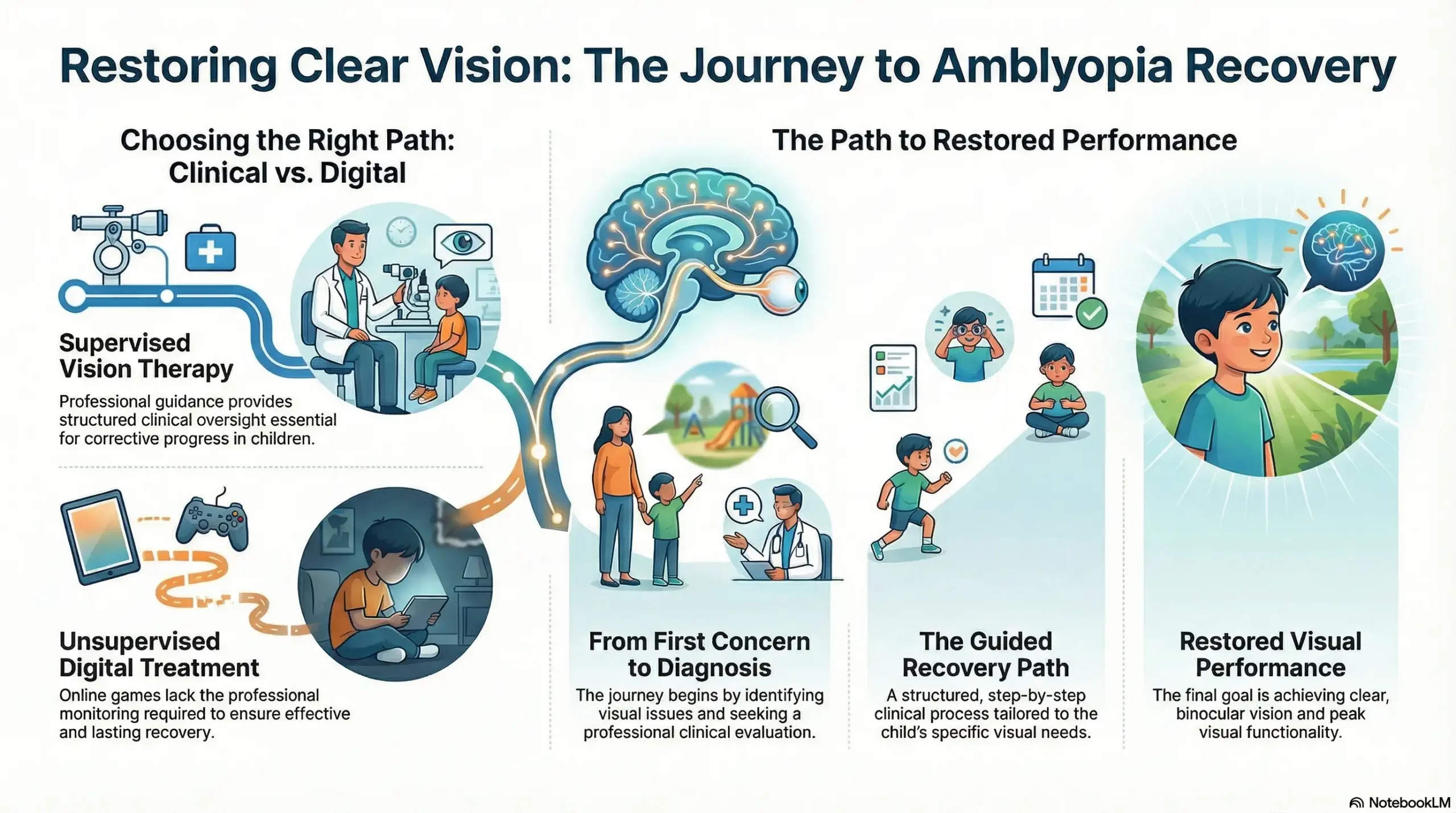
| Stage | What Happens | Your Child’s Outcome |
|---|---|---|
| Step 1: Awareness | Parent notices child struggling to read, covering one eye, or tilting head | Recognition that vision may be the root cause |
| Step 2: Free Phone Consult | Call (770) 419-0400 — speak directly with our expert team | Immediate guidance, zero pressure |
| Step 3: Vision Therapy Evaluation | Comprehensive diagnostic evaluation at our Marietta, GA clinic | Clear diagnosis and personalized treatment plan |
| Step 4: Personalized Therapy Program | In-office sessions + at-home exercises tailored to your child | Progressive improvement in visual acuity and binocular vision |
| Step 5: Restored Visual Performance | Child reads with ease, gains confidence, thrives academically | Life-changing results — for the long term |
Warning Signs Your Child’s Lazy Eye Needs Professional Attention — Not Just an App
If you are still weighing whether to pursue professional evaluation, these behavioral signs — observed at home or reported by a teacher — are your clearest signal that it is time to act.
Behavioral Signs to Watch For at Home and School
Children with amblyopia and related binocular vision disorders often display a recognizable pattern of behaviors that parents and educators may misattribute to attention issues, learning disabilities, or simply “not trying hard enough.” Watch for a child who struggles to read despite being bright and verbally capable, who frequently covers or closes one eye to focus, who tilts their head at an unusual angle when reading or watching, who becomes frustrated or emotional during homework, or who avoids reading and close work activities altogether.
These are not character traits. They are symptoms — and they are treatable.
When to Stop Waiting and Call a Vision Therapy Specialist
If your child displays two or more of the signs above, or if they have already received an amblyopia diagnosis and you are uncertain whether their current treatment plan is working, it is time to seek a specialist’s evaluation. The critical developmental window for visual system treatment is real, and every month of delay matters. A Free Phone Consultation with our team at Cook Vision Therapy Center costs nothing and could change everything.
📍 Local Resources & Citations
1. Georgia Department of Public Health — Child Vision Screening Program: Check here for Georgia’s official pediatric vision screening guidelines, school-age screening mandates, and state-recognized standards for early detection of amblyopia and other childhood vision disorders.
2. Cobb County School District — Student Health Services: Reference this resource to understand the vision screening procedures and health referral process used in Marietta-area public schools, which is often a family’s first indicator that a child may need a specialist evaluation.
3. National Eye Institute (NEI) — U.S. National Institutes of Health: The federal government’s primary source for evidence-based clinical research on amblyopia, dichoptic therapy, and lazy eye treatment outcomes — the same research body whose PEDIG studies underpin supervised vision therapy protocols.
4. American Optometric Association — Amblyopia Clinical Guidelines: Consult this official professional body for the nationally recognized clinical care guidelines that board-certified optometrists — including Fellows of the College of Optometrists in Vision Development — follow when diagnosing and treating lazy eye in children.
Take the First Step Toward Your Child’s Clearer Future
Your child is bright. Their potential is real. And if an undiagnosed or undertreated vision condition is standing between them and the life they deserve — that is something we can help with.
Online vision games may have a role to play as part of a carefully supervised treatment plan. But they are never the starting point, and they are never the whole answer. The starting point is understanding exactly what is happening in your child’s visual system — and building a personalized, expert-guided plan to address it.
At Cook Vision Therapy Center, that is precisely what we do — one patient, one family, one life-changing outcome at a time.
🌟 Contact Cook Vision Therapy Center — Marietta’s trusted amblyopia and vision therapy specialists.
📍 1395 South Marietta Pkwy SE, Bldg 400, Ste 107, Marietta, GA 30067
📞 (770) 419-0400
🌐 cookvisiontherapy.com
Call today to schedule your child’s comprehensive Vision Therapy Evaluation — and discover the patching-free path to restored visual performance.
Frequently Asked Questions
-
They are digital therapeutic exercises designed to train both eyes to work together. These programs use gamified tasks to strengthen the weaker eye and improve overall binocular vision.