How Functional Vision Affects Learning and Performance

Functional vision problems occur when the eyes and brain fail to coordinate efficiently, often causing bright children to struggle with reading and focus despite having 20/20 distance vision. This guide explores how specialized visual skills—like eye tracking and teaming—impact academic performance and how evidence-based vision therapy can unlock your child’s learning potential.
Schedule a Functional Vision Evaluation in Marietta
What Is Functional Vision?
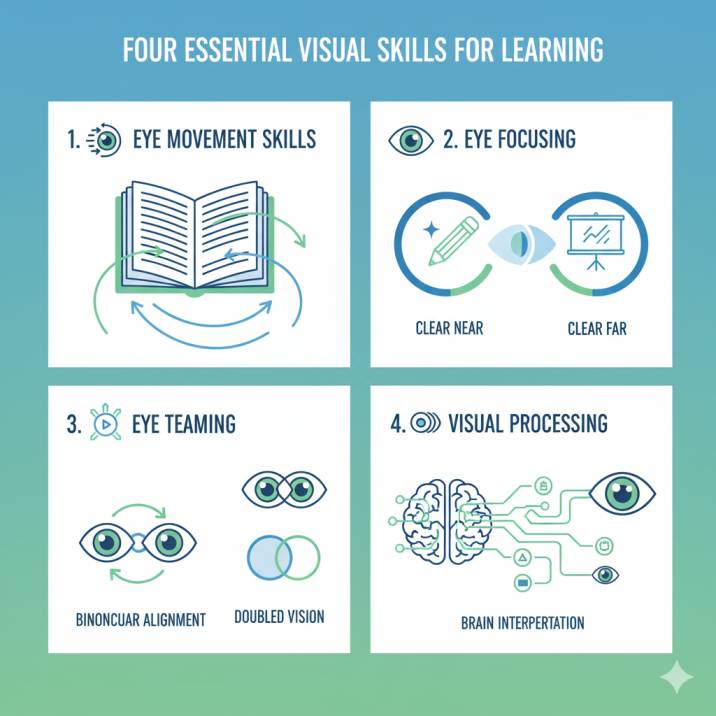
Functional vision goes far beyond seeing letters clearly on an eye chart. It encompasses the sophisticated visual skills that allow us to process, interpret, and respond to visual information efficiently. Unlike basic visual acuity (the sharpness of vision), functional vision involves how well your eyes work together as a team and how effectively your brain processes the visual information it receives.
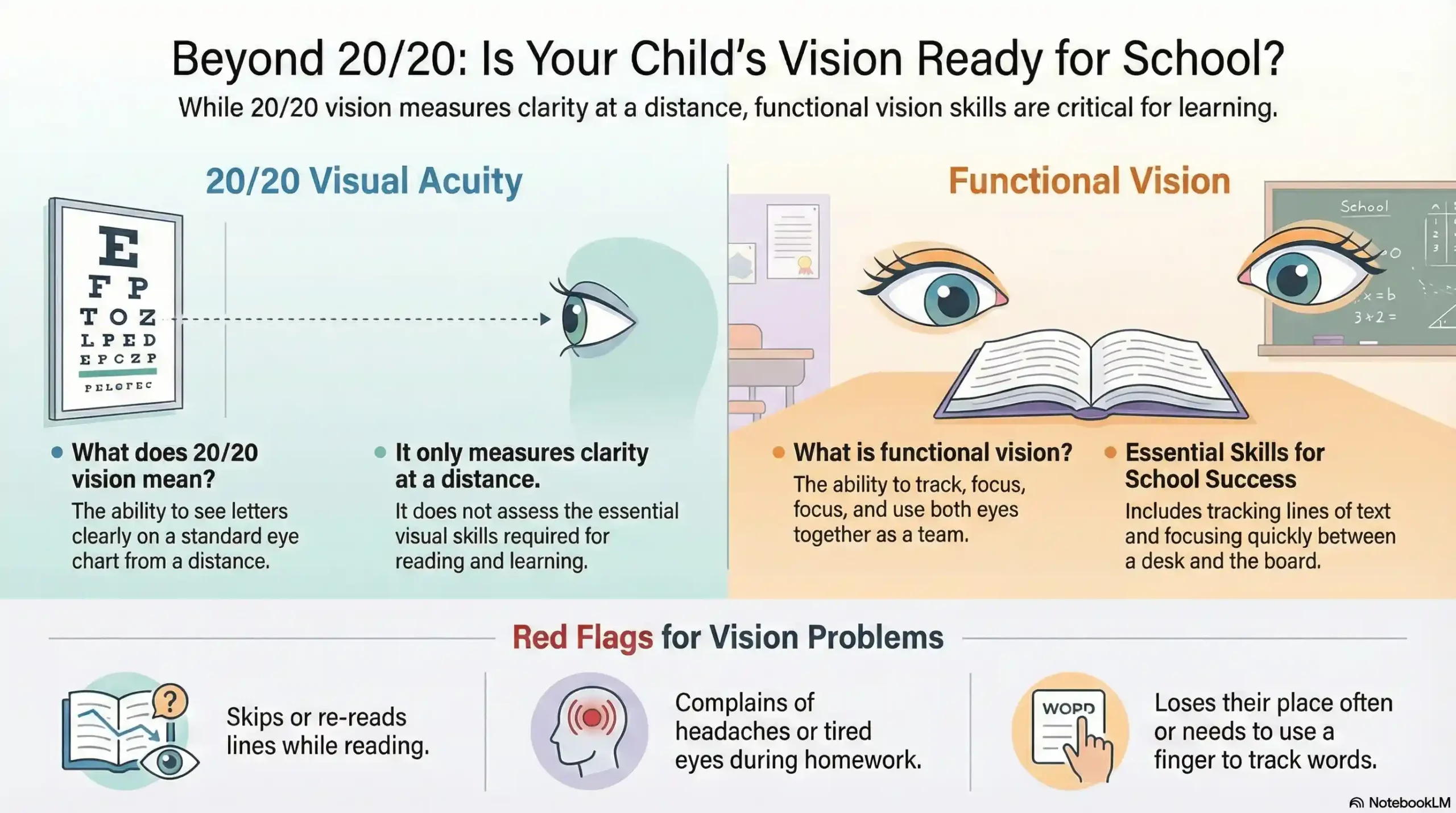
The visual system requires seamless coordination of multiple skills, including:
- Eye movement control (oculomotor function)
- Binocular coordination (eye teaming)
- Focusing abilities (accommodation)
- Higher-level visual processing
When any of these components malfunction, learning difficulties often follow—even when distance vision appears perfect.
Key Insight: Research indicates that the majority of learning occurs through visual pathways, with studies suggesting that visual information processing plays a critical role in academic success. When functional vision problems interfere with this process, children may struggle academically despite having normal intelligence and clear distance vision.
The Four Essential Visual Skills for Learning
Research has identified four critical functional vision skills that directly impact academic performance:
1. Eye Movement Skills (Oculomotor Function)
Smooth, efficient eye movements are essential for reading success. Your eyes must track smoothly across lines of text, make precise jumps between words (saccades), and maintain steady fixation on targets.
When eye movement skills are impaired:
- Children lose their place while reading
- Words appear to move or jump on the page
- Reading speed and comprehension suffer
- Students frequently skip lines or words
Recent studies show that 80% of children with reading difficulties demonstrate deficiencies in saccadic eye movements, highlighting the critical connection between eye movement control and academic success.
2. Eye Focusing (Accommodation)
The ability to maintain clear focus at different distances and rapidly shift focus between near and far objects is crucial for classroom learning. Students constantly switch their focus from their desk work to the whiteboard and back again throughout the school day.
Signs of focusing problems:
- Blurred vision when reading or doing close work
- Headaches after visual tasks
- Difficulty copying from the board
- Fatigue during homework
3. Eye Teaming (Binocular Vision)
Both eyes must work together in perfect coordination to create a single, clear image. This binocular cooperation provides depth perception and prevents double vision during close work.
Understanding Convergence Insufficiency
Convergence insufficiency represents one of the most common eye-teaming problems, affecting 2-8% of school-aged children, with most studies reporting around 5%. Recent 2024 research among Spanish children found a 5.3% prevalence rate, while screening studies show that approximately 20% of children exhibit 2-3 signs of convergence insufficiency.
This condition makes it difficult for the eyes to turn inward together when focusing on close objects, leading to:
Physical Symptoms:
- Double or blurred vision
- Eye strain and headaches
- Fatigue during reading
Academic Impact:
- Poor reading comprehension
- Avoidance of close work
- Difficulty concentrating
- Reduced homework completion
4. Visual Processing
Beyond basic vision lies visual processing—the brain’s ability to interpret and make sense of visual information. This includes visual memory, spatial awareness, visual discrimination, and the ability to recognize patterns and relationships.
Visual processing problems can cause:
- Difficulty recognizing letters and numbers
- Trouble with visual memory tasks
- Problems with visual-spatial relationships
- Challenges in mathematics and reading comprehension
How Functional Vision Problems Impact Academic Performance
Reading and Language Arts
Functional vision problems create significant barriers to reading success:
Reading Fluency: Children with eye movement disorders may read slowly, skip words, or lose their place frequently. Instead of reading smoothly, they struggle to decode individual words, preventing them from understanding the overall meaning.
Reading Comprehension: When children must exert extra effort to keep words clear and single, their cognitive resources are depleted, leaving insufficient mental energy for comprehension.
Writing Skills: Poor eye-hand coordination and visual processing difficulties can affect handwriting, spacing, and organization of written work.
Mathematics
Visual skills play a crucial role in mathematical success:
- Difficulty seeing math symbols clearly (decimals, plus/minus signs)
- Problems aligning numbers in columns
- Trouble with the visual-spatial aspects of geometry
- Challenges in organizing work on paper
Research indicates that visual-motor integration skills are among the strongest predictors of mathematical achievement in elementary school children.
Attention and Behavior
Functional vision problems often masquerade as attention disorders. Children who struggle with eye strain, double vision, or focusing problems may appear:
- Hyperactive or restless during visual tasks
- Inattentive or distractible
- Avoidant of reading and homework
- Prone to behavioral outbursts related to frustration
Studies reveal that five out of nine criteria for ADHD diagnosis overlap with symptoms of convergence insufficiency, highlighting the importance of comprehensive vision evaluation before considering an ADHD diagnosis.
Recent Research Findings
Study 1: Vision Therapy Effectiveness for Learning Disabilities (2018)
Research Highlight: A landmark study published in the Journal of Optometry examined 94 children with specific learning disorders and found that 76% had non-strabismic binocular vision anomalies.
Key Findings:
- After vision therapy treatment, children showed significant improvements in both visual parameters and reading rates.
- Demonstrates the direct connection between vision therapy and academic performance
- Supports early intervention for learning-related vision problems
Study 2: Academic Behaviors and Convergence Insufficiency (2019)
Research Highlight: Published in Optometry and Vision Science, this study followed 212 children with convergence insufficiency and compared them to children with normal binocular vision.
Key Findings:
- Parents reported significantly higher rates of academic problems in children with convergence insufficiency.y
- After successful vision therapy treatment, academic behaviors improved dramatically.
- Reduced homework completion difficulties and improved concentration were observed
Study 3: Visual Processing in Complex Environments (2024)
Research Highlight: A groundbreaking study published in Scientific Reports examined 1,044 primary school students and their performance in complex visual environments.
Key Findings:
- Nearly 50% of students demonstrated poor visual processing abilities in a challenging visual task.s
- Significant impacts on language scores, particularly among first-grade students
- Traditional vision screenings may miss complex visual processing challenges.
Clinical Significance: These studies collectively demonstrate that functional vision problems are more prevalent than previously recognized and have measurable impacts on academic performance that can be effectively treated with vision therapy.
Warning Signs: Is Your Child Struggling with Functional Vision Problems?
Parents and teachers should watch for these red flags that may indicate functional vision problems:
Academic Warning Signs
- Bright child underperforming academically
- Inconsistent academic performance
- Avoidance of reading or homework
- Slow reading speed despite adequate instruction
- Poor reading comprehension
- Difficulty copying from the board
- Problems with math alignment and organization
Physical Symptoms
- Frequent headaches, especially after visual tasks
- Eye strain or tired eyes
- Rubbing eyes frequently
- Covering one eye when reading
- Tilting the head while reading or writing
- Complaints of blurred or double vision
Behavioral Indicators
- Short attention span for visual tasks
- Restlessness during homework
- Frequent breaks are needed during reading
- Behavioral problems related to schoolwork
- Saying “words move on the page”
The Assessment Process: Beyond 20/20
Traditional school vision screenings and basic eye exams often miss functional vision problems. A comprehensive functional vision evaluation should assess:
- Visual acuity at multiple distances
- Eye movement skills (tracking, saccades, fixation)
- Binocular vision function (convergence, divergence, eye teaming)
- Accommodative function (focusing, flexibility, and stamina)
- Visual processing skills (visual memory, spatial awareness, visual motor integration)
This specialized testing typically requires 60-90 minutes and should be performed by a developmental or behavioral optometrist with expertise in learning-related vision problems.
Treatment Options: Evidence-Based Solutions
Vision Therapy: The Gold Standard
Vision therapy represents the most effective treatment for most functional vision disorders. This supervised program of visual activities and exercises is designed to correct vision problems and improve visual skills.
Proven Success Rates
Research shows that vision therapy:
- Successfully treats convergence insufficiency in 75-87% of cases, with recent studies showing 87.5% success rates for symptomatic convergence insufficiency in school children
- Significantly improves reading rates and comprehension
- Reduces academic behavior problems
- Provides lasting improvements in visual function
What to Expect
Vision therapy typically includes:
- Duration: 12-24 weeks of treatment
- In-office sessions with a trained vision therapist (45-60 minutes weekly)
- Home-based reinforcement exercises (15-30 minutes daily)
- Specialized equipment and techniques tailored to individual needs
- Progress monitoring and program adjustment as needed
Important: Vision therapy requires commitment from both the child and family, but the long-term benefits often justify the investment in improved academic performance and quality of life.
Specialized Lenses
In some cases, specialized corrective lenses may provide immediate relief:
- Prism lenses for eye alignment problems
- Reading glasses for focusing difficulties
- Special coatings to reduce glare and visual stress
- Computer glasses for digital device use
Environmental Modifications
Simple environmental changes can support visual comfort while undergoing treatment:
- Proper lighting for reading and homework areas
- Reducing glare from windows and screens
- Appropriate seating distance from whiteboards
- Regular visual breaks during close work (20-20-20 rule)
Why Early Intervention Matters
The visual system continues developing throughout childhood, making early intervention crucial. Children who receive appropriate treatment for functional vision problems often experience:
- Dramatic improvements in reading skills
- Better academic performance across subjects
- Increased confidence and self-esteem
- Reduced behavioral problems related to visual stress
- Enhanced sports performance and coordination
Research demonstrates that the earlier functional vision problems are identified and treated, the more successful the outcomes. Children who struggle for years with undiagnosed vision problems may develop avoidance behaviors and negative associations with learning that become increasingly difficult to overcome.
The Cook Vision Therapy Center Difference
At Cook Vision Therapy Center in Marietta, Georgia, Dr. David Cook brings over 40 years of specialized experience in diagnosing and treating functional vision problems. Unlike general eye care practices that focus primarily on glasses and contact lenses, our center specializes exclusively in vision therapy and developmental optometry.
Why Choose Cook Vision Therapy Center?
Our comprehensive approach includes:
- ✅ Thorough functional vision evaluations (60-90 minute comprehensive testing)
- ✅ Customized vision therapy programs designed for individual needs
- ✅ Family education and support throughout the treatment process
- ✅ Collaboration with schools and other professionals
- ✅ Long-term follow-up care to ensure lasting results
Dr. Cook’s credentials:
- 40+ years of specialized experience in developmental optometry
- International recognition as a vision therapy expert
- Thousands of successful patient treatments
- Serving families throughout the Atlanta metro area
Service Areas
We proudly serve families from:
- Marietta, GA (primary location)
- Atlanta metro area
- Roswell, Alpharetta, and North Fulton County
- Cobb County and surrounding communities
Moving Forward: Steps for Concerned Parents
If you suspect your child may have functional vision problems affecting their academic performance, consider these steps:
1. Document Symptoms
Keep a record of your child’s visual symptoms and academic struggles. Note when problems occur and any patterns you observe.
2. Request Comprehensive Evaluation
Schedule a comprehensive functional vision evaluation with a developmental optometrist. This specialized testing goes far beyond basic eye exams.
3. Collaborate with Schools
Share evaluation results with teachers and school support staff. Many classroom accommodations can help while your child receives treatment.
4. Consider Vision Therapy
If functional vision problems are identified, discuss vision therapy options. Research strongly supports its effectiveness for most vision-related learning difficulties.
5. Be Patient and Supportive
Recovery from functional vision problems takes time. Encourage and celebrate small improvements as your child’s visual system develops.
References and Resources
The information in this article is based on peer-reviewed research and clinical studies. Here are key resources for further reading:
Recent Scientific Studies
- Tian, Y.J., Chen, C., Zhang, X.H. et al. (2024). An investigation into the correlation between visual performance in simulated complex environments and academic attainment among primary school students. Scientific Reports, 14, 5879.
https://www.nature.com/articles/s41598-024-56548-7 - Carla, S.C., Sara, B.F., Jm, C.R., Catalina, P.Á. (2022). Prevalence of convergence insufficiency among Spanish school children aged 6 to 14 years. Journal of Optometry, 15(4), 278-283.
https://www.journalofoptometry.org/en-prevalence-convergence-insufficiency-among-spanish-articulo-S1888429621000893 - Clavé, L., Torrents, A. (2025). Convergence insufficiency prevalence in attention deficit and hyperactivity disorder depends on the diagnostic criteria. Ophthalmic and Physiological Optics, 45(1), 23-30.
https://onlinelibrary.wiley.com/doi/10.1111/opo.13411
Conclusion: Unlocking Your Child’s Learning Potential
Functional vision problems represent one of the most overlooked causes of learning difficulties in school-age children. When bright, motivated children struggle academically despite adequate instruction and support, functional vision should be investigated as a potential contributing factor.
The research is clear: addressing functional vision problems can dramatically improve academic performance, reading skills, and overall quality of life for affected children. With proper evaluation and evidence-based treatment through vision therapy, most children with functional vision problems can achieve significant improvement in their visual skills and academic success.
Don’t let undiagnosed functional vision problems limit your child’s potential. If your child struggles with reading, homework completion, or attention during visual tasks, consider scheduling a comprehensive functional vision evaluation. Early identification and intervention can make the difference between ongoing academic struggles and unlocking your child’s true learning capacity.
Remember, 20/20 vision is just the beginning. True visual success requires the sophisticated coordination of multiple visual skills working together seamlessly. When these systems function optimally, learning becomes easier, more efficient, and more enjoyable—allowing your child to reach their full academic potential.
Ready to help your child succeed? Contact Cook Vision Therapy Center today to schedule a comprehensive functional vision evaluation and discover if vision therapy can unlock your child’s learning potential.
For more information about functional vision evaluation and vision therapy services, contact Cook Vision Therapy Center in Marietta, Georgia. Dr. David Cook’s four decades of experience in developmental optometry have helped thousands of children overcome vision-related learning difficulties and achieve academic success.
FAQs
-
Functional vision refers to how well the eyes work together to focus, track, and process visual information during daily activities. It affects learning by impacting reading comprehension, writing skills, focus duration, and the ability to remember visual information.