Does Pseudostrabismus Go Away on Its Own? A Marietta, GA Expert Explains

Pseudostrabismus often resolves on its own as a child’s facial features naturally mature — typically between ages one and five — because the condition is caused by physical characteristics like a wide nasal bridge or epicanthal folds, not by actual eye misalignment. However, it only resolves if the diagnosis is truly pseudostrabismus. Because true strabismus can closely mimic pseudostrabismus, a professional evaluation by a qualified vision specialist is essential to confirm the diagnosis, protect your child’s developing vision, and ensure no underlying condition is being missed.
You are scrolling through photos of your child and something catches your eye. Their eyes look crossed — one seems to drift inward, creating an unsettling asymmetry you cannot stop thinking about. You mention it at the next pediatric visit and hear the words: “It’s probably pseudostrabismus. They’ll likely grow out of it.”
For many parents, that answer brings relief. For others, it brings a different kind of worry: How do we know for certain? What if they don’t grow out of it? What if something real is being missed?
Those questions are not just valid — they are exactly the right ones to ask. Understanding the difference between pseudostrabismus and true strabismus, knowing what to watch for, and understanding when to seek a specialist evaluation can make a profound difference in your child’s visual development, academic performance, and quality of life. This guide, informed by decades of pediatric vision expertise right here in Marietta, GA, gives you the clear answers you deserve.
What Is Pseudostrabismus? Understanding the “Fake Crossed Eyes” Diagnosis
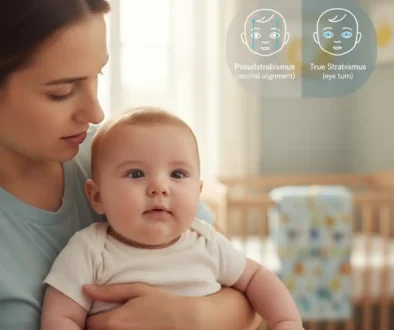
Pseudostrabismus — sometimes called “false strabismus” — is a condition in which a child’s eyes appear to be misaligned or crossed, when in reality they are tracking and functioning normally. It is not a disease, a disorder, or a sign that anything is wrong with your child’s vision. It is, at its core, an optical illusion created by the normal physical features of a young child’s face.
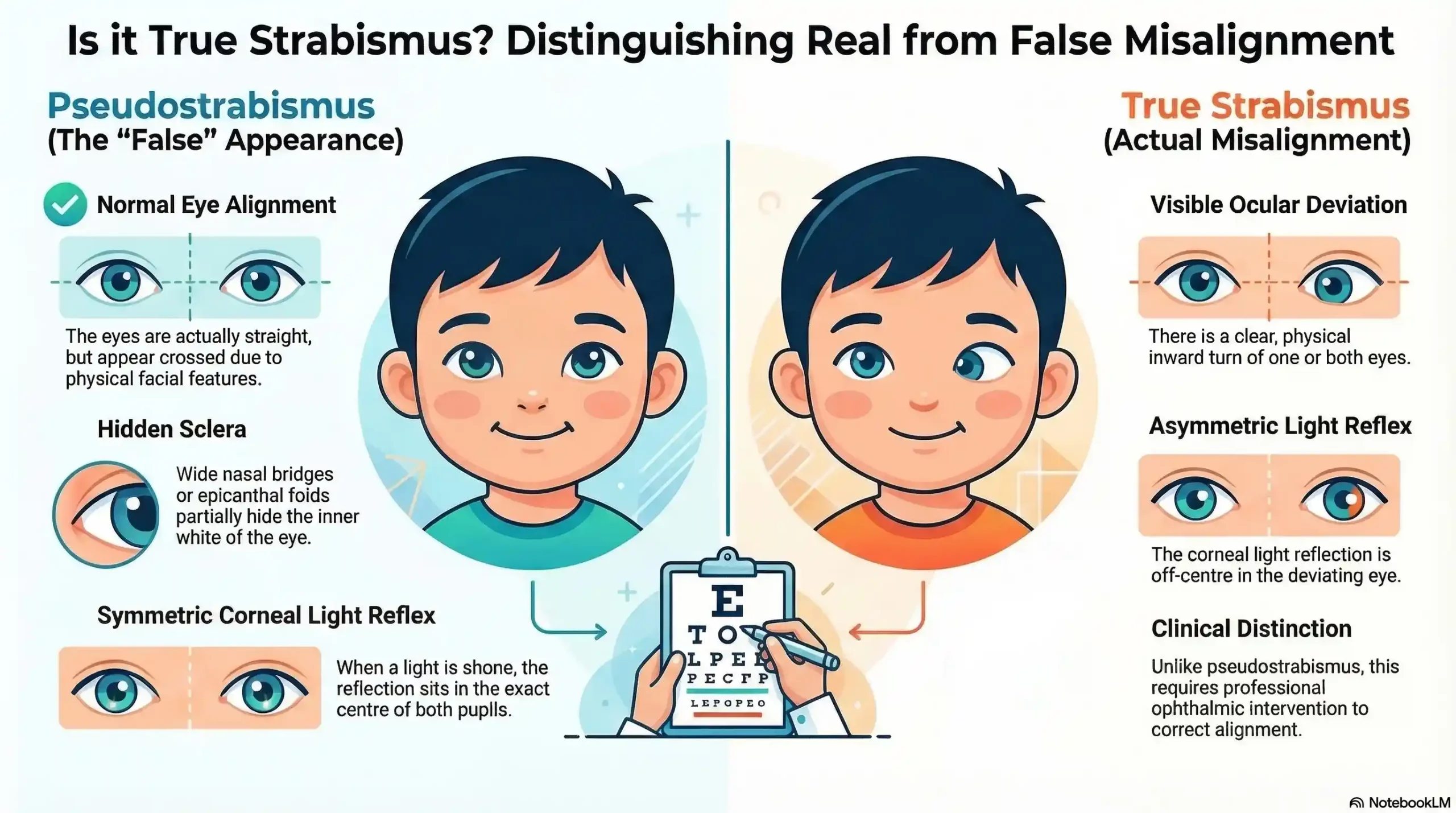
The most common causes include a wide nasal bridge, prominent epicanthal folds (small folds of skin at the inner corners of the eyes, especially common in infants), and eyes positioned closer together than in adulthood. These features partially obscure the white of the eye on the inner side, making the eye appear to turn inward even when it is perfectly straight.
Pseudostrabismus is most frequently observed in infants and toddlers, typically from birth through approximately age three. As a child grows, the nasal bridge narrows, the epicanthal folds recede, and the illusion naturally disappears. In these true cases, no treatment is required.
| Feature | Pseudostrabismus | True Strabismus |
|---|---|---|
| Eye Alignment | Normal | Misaligned |
| Cause | Wide nasal bridge / epicanthal folds | Muscle or neurological issue |
| Corneal Light Reflex | Centered symmetrically in both eyes | Off-center in one or both eyes |
| Resolves with age? | Usually yes | Requires professional treatment |
| Vision at risk? | No | Yes — amblyopia risk present |
| Requires treatment? | No | Yes — vision therapy or intervention |
Does Pseudostrabismus Go Away on Its Own?
In most cases, yes — genuine pseudostrabismus resolves naturally as a child’s facial anatomy matures. As the nasal bridge develops and the epicanthal folds gradually reduce, the visual illusion of crossed eyes disappears without any medical intervention. This process typically unfolds between ages one and five, though the timeline varies from child to child.
This is genuinely reassuring news for many families. If your child has been professionally evaluated and pseudostrabismus has been confidently confirmed, watchful waiting combined with routine monitoring is entirely appropriate.
However, there is a critical distinction that every parent must understand: pseudostrabismus only resolves if the diagnosis is correct.
True strabismus — a real, physical misalignment of the eyes caused by muscle imbalance or neurological factors — does not resolve on its own. Left untreated, true strabismus carries serious consequences. The brain, receiving two conflicting images, will begin to suppress the signal from the weaker eye. Over time, this suppression leads to amblyopia, commonly known as lazy eye—a condition characterized by a permanent reduction in visual acuity in the affected eye. Untreated strabismus also destroys the development of binocular vision, eliminating depth perception and 3D vision that are critical for reading, sports, driving, and countless everyday activities.
The danger is not pseudostrabismus itself. The danger is assuming that a crossed-eye appearance in a young child is automatically benign without confirmation from a trained vision specialist.
Pseudostrabismus vs. True Strabismus — How to Tell the Difference
The single most reliable method for distinguishing pseudostrabismus from true strabismus is the Hirschberg corneal light reflex test, performed by a qualified eye care professional. During this test, a small penlight is directed toward the child’s eyes. In a child with pseudostrabismus, light reflects symmetrically and centrally in both pupils, confirming the eyes are properly aligned despite their appearance. In a child with true strabismus, the light reflex is asymmetric, appearing off-center in the misaligned eye.
This test is simple, non-invasive, and takes only seconds — but it requires a trained clinician to interpret correctly. It is not a home diagnosis tool.
Warning Signs Parents Should Never Ignore
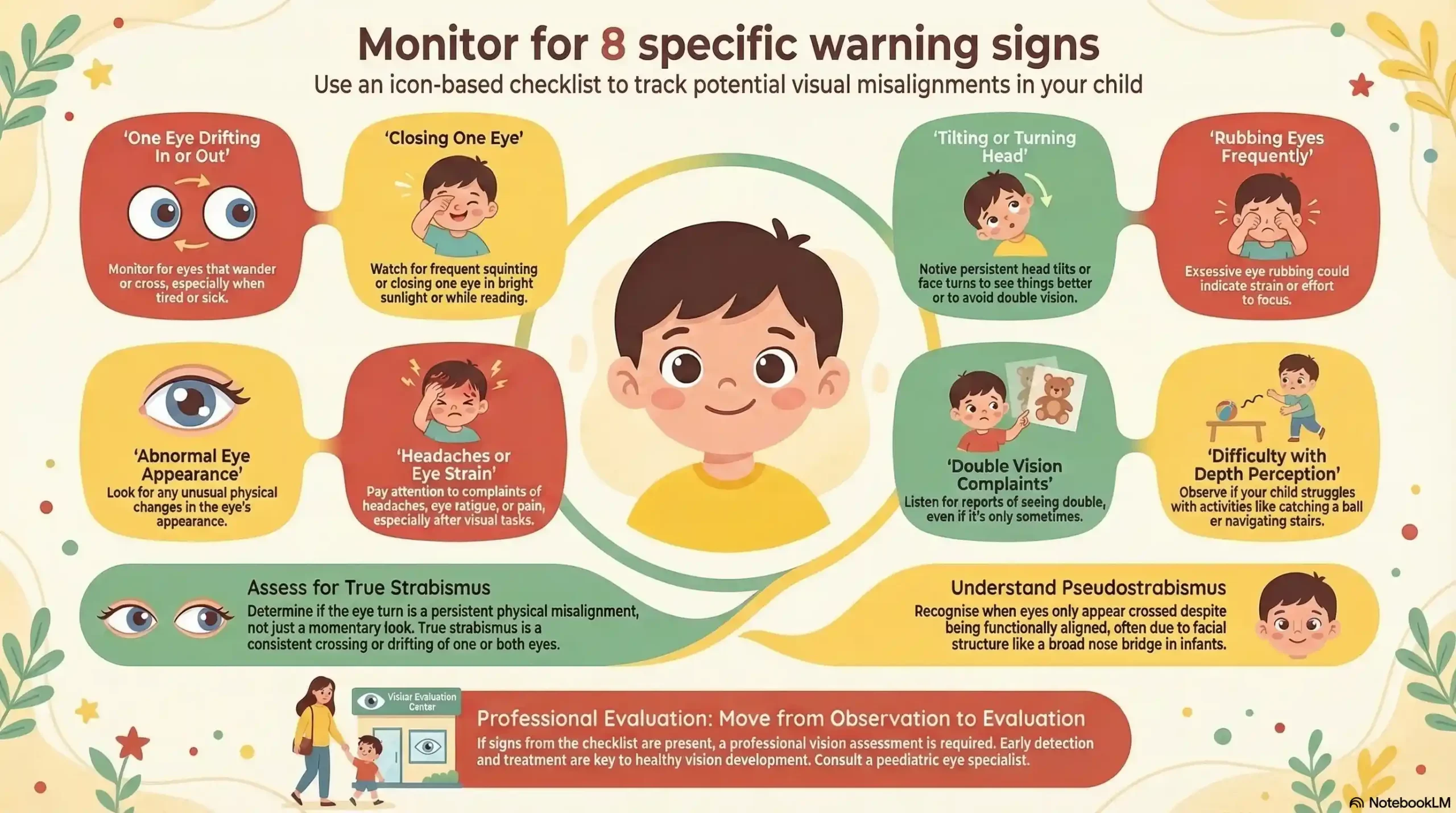
While a professional evaluation is the only definitive answer, certain behavioral and visual signs can indicate that a child’s eye crossing is more than an illusion. Contact a vision specialist promptly if your child shows any of the following:
- Eyes that drift inward, outward, upward, or downward consistently — not just in photographs
- Tilting or turning the head to one side to focus on objects
- Squinting or closing one eye, particularly in bright light or during near tasks
- Complaints of double vision, blurred vision, or visual discomfort
- Difficulty with depth perception — bumping into furniture, struggling to catch or kick a ball
- Avoiding reading, drawing, or near-work activities with unusual persistence
- Eye rubbing, excessive blinking, or facial grimacing during visual tasks
- Reluctance to be photographed due to awareness of the eye appearance
| Warning Sign | Pseudostrabismus | True Strabismus |
|---|---|---|
| Eyes appear crossed in photos | ✅ Common | ✅ Common |
| Consistent eye turn in all lighting conditions | ❌ Unlikely | ✅ Yes |
| Head tilting or turning to focus | ❌ No | ✅ Yes |
| Complaints of double or blurred vision | ❌ No | ✅ Yes |
| Asymmetric corneal light reflex | ❌ No | ✅ Yes |
| Avoidance of reading or near-work | ❌ No | ✅ Yes |
| Appearance improves in bright, direct light | ✅ Often | ❌ No |
| Depth perception difficulties | ❌ No | ✅ Yes |
📞 Not sure if your child’s eye crossing is real or pseudostrabismus? The team at Cook Vision Therapy Center is here to help you find a clear, confident answer. We offer a Free Phone Consultation — no pressure, no obligation, just expert guidance from a team that has helped thousands of families across Metro Atlanta. Call us today at (770) 419-0400.
Can Pseudostrabismus Turn Into Real Strabismus?
This is one of the most common questions parents ask — and the answer requires careful nuance. Pseudostrabismus, as a condition defined by normal eye alignment, does not itself “turn into” true strabismus. The physical characteristics that create the illusion — a wide nasal bridge, epicanthal folds — are simply features of a young face, and they do not cause eye muscle problems or neurological misalignment.
However, there is an important clinical reality that parents deserve to understand: some children initially thought to have pseudostrabismus are later found to have intermittent strabismus — a form of true strabismus in which the eye turn comes and goes rather than being constant. Because intermittent strabismus is, by definition, not always present, it can be easily overlooked during a brief pediatric wellness visit, leading to a premature diagnosis of pseudostrabismus.
This is precisely why ongoing monitoring matters. A child whose eyes “look crossed” should not simply be observed at home and re-evaluated at the next annual pediatric visit. The stakes — the risk of developing amblyopia and losing binocular vision — are too significant to leave to chance. Regular evaluations with a specialist trained in pediatric binocular vision provide the certainty that a general screening cannot.
When Should You See a Vision Specialist in Marietta, GA?
General guidance from pediatric vision organizations recommends that any perceived eye turn in a child older than four to six months warrants professional evaluation. In younger infants, occasional eye crossing can be a normal part of early neurological development as the visual system matures. Beyond that window, it should be assessed.
Seek a vision specialist evaluation promptly if:
- Your pediatrician has expressed concern or provided a referral for eye alignment
- You notice any of the warning signs listed above — even occasionally
- Your child’s eye appearance has not noticeably improved by age two to three
- A family history of strabismus, amblyopia, or vision therapy exists
- Your child is struggling academically in ways that seem disconnected from their intelligence
- You simply want peace of mind — a definitive answer from a qualified expert
Families across Metro Atlanta — in Marietta, Kennesaw, Roswell, Smyrna, Acworth, and throughout Cobb County — have trusted Cook Vision Therapy Center for exactly this kind of clarity. Led by Dr. David L. Cook, O.D., F.A.A.O., F.C.O.V.D., an internationally recognized clinician, author, and educator with over forty years of experience in vision therapy and pediatric visual development, Cook Vision Therapy Center provides comprehensive evaluations that go far beyond a standard eye exam — giving families the definitive answers they need to move forward with confidence.
🏆 Cook Vision Therapy Center — Metro Atlanta’s Trusted Vision Therapy Authority Dr. David L. Cook has helped thousands of children and families across Marietta, Kennesaw, Roswell, Smyrna, and the greater Atlanta region — and beyond. With over 40 years of specialized experience, our team delivers evaluations and personalized care plans that standard eye exams simply cannot provide. Schedule your child’s Vision Therapy Evaluation today. 📍 1395 South Marietta Pkwy SE, Bldg 400, Ste 107, Marietta, GA 30067 📞 (770) 419-0400
How Cook Vision Therapy Center Evaluates and Treats Childhood Eye Conditions
The Vision Therapy Evaluation — What to Expect
A Vision Therapy Evaluation at Cook Vision Therapy Center is a comprehensive, multi-dimensional assessment that extends well beyond checking whether your child can read the letters on a standard eye chart. Our evaluation examines the full spectrum of visual function — including binocular vision, eye teaming, depth perception, eye tracking accuracy, convergence, and visual processing — to produce a complete picture of how your child’s visual system is truly performing.
This thorough process enables our team to definitively confirm or rule out pseudostrabismus, identify true strabismus at any severity, detect amblyopia in its earliest stages, and uncover other conditions—such as convergence insufficiency or visual processing disorders—that may be contributing to academic or developmental challenges. Every finding is personalized. Every care plan is tailored to your child’s unique visual profile and life demands.
Non-Surgical, Patching-Free Vision Therapy for Strabismus
When true strabismus or another binocular vision condition is identified, Cook Vision Therapy Center offers a proven, non-surgical path forward. Our vision therapy programs are specifically designed to retrain the visual system — building the eye muscle coordination, binocular integration, and neurological pathways necessary for straight, comfortable, high-performance vision.
Our approach is structured, medically supervised, and entirely personalized — combining focused in-office therapy sessions with targeted at-home exercises that reinforce progress between visits. Goals include achieving straight eyes, restoring 3D vision and depth perception, improving eye-body coordination, and eliminating symptoms—headaches, double vision, and reading avoidance—that diminish daily life.
Critically, vision therapy is effective for both children and adults. It is never too late to seek help. For patients outside Metro Atlanta, Cook Vision Therapy Center also offers personalized distance vision therapy programs following an initial in-person evaluation, making world-class care accessible wherever you are.
🏛️ Local Resources & Citations
1. Georgia Department of Public Health — Health Check Program (.gov) Georgia’s Health Check Program provides vision screenings and developmental assessments for children of all ages. This official state resource to locate a Health Check provider near Marietta and to understand what vision screenings your child is entitled to under Georgia’s EPSDT program.
2. Cobb County School District — Vision Screening Program (.org — Official School District) The Cobb County School District conducts mandatory vision screenings for students in Grades 1, 4, 7, and 10, and for all new students entering the district — if your child receives a referral letter after failing a school screening, this page explains the next steps and confirms that a comprehensive eye evaluation by a licensed optometrist or vision specialist is the recommended follow-up.
3. National Eye Institute (NIH) — Amblyopia Resource (.gov) The NEI notes that strabismus — where one eye drifts in, out, up, or down — is a leading cause of amblyopia in children, and that early detection through vision screening between ages 3 and 5 is critical — this federal resource explains in plain language why an undetected eye misalignment that appears to be pseudostrabismus can silently develop into permanent vision loss if left unaddressed.
4. Georgia DPH — Form 3300: Certificate of Vision, Hearing, Dental & Nutrition Screening (.gov) Georgia state law requires all children entering a public school for the first time to file a completed Form 3300, which mandates vision screening — and if a child is flagged as “needs further evaluation,” parents are directed to take the child to a professional for a more detailed assessment — download this mandatory state form here and use the referral result as the prompt to schedule a comprehensive vision evaluation at a specialist such as Cook Vision Therapy Center.
Real Results from Real Families in Metro Atlanta
The measure of any healthcare practice is not its credentials alone — it is the lives it changes. Cook Vision Therapy Center has built a legacy of transformation across Metro Atlanta, documented in the experiences of the families who have walked through our doors in Marietta, GA.
Parents describe the profound relief of discovering a non-surgical solution for their child’s strabismus — particularly after other providers had pushed invasive procedures as the only option. They speak of watching a previously struggling child rediscover confidence, excel academically, and no longer dread homework. Adults describe reclaiming independence — returning to driving, to reading, to the activities that make life full — after vision problems following neurological events had taken those abilities away.
These are not isolated stories. With over 57 Google reviews reflecting the experiences of a community of patients served across the Southeast — and beyond — Cook Vision Therapy Center’s reputation is built on a foundation of real, lasting, life-changing outcomes.
✨ Your child’s vision journey starts with one call. Whether it turns out to be pseudostrabismus or something that requires expert attention, you deserve a clear, confident answer from a specialist you can trust. Don’t wait and wonder. Call Cook Vision Therapy Center today and take the first step toward clarity, confidence, and restored visual performance. 📞 (770) 419-0400 📍 1395 South Marietta Pkwy SE, Bldg 400, Ste 107, Marietta, GA 30067 🌐 cookvisiontherapy.com Begin Your Journey to Restored Visual Performance Today.
Frequently Asked Questions
-
Pseudostrabismus is a condition in which a child’s eyes appear crossed or misaligned but are actually pointing in the correct direction. Physical facial features cause it — most commonly a wide nasal bridge or prominent epicanthal folds — that create the visual illusion of an eye turn. It is not a disease and does not affect vision. A professional eye evaluation confirms the diagnosis.
Disclaimer:
This article is for educational purposes only and does not replace a professional eye examination. If you notice signs of eye misalignment or have concerns about your child’s vision, consult a qualified eye care professional for an accurate diagnosis and personalized care.