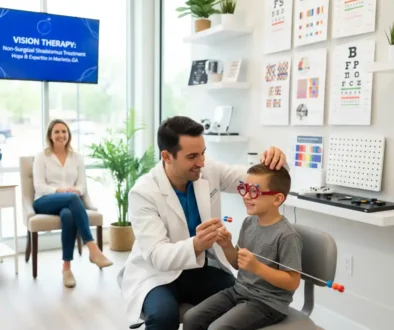
How Long Does It Take to Fix a Lazy Eye? What Patients Need to Know

How long does it take to fix a lazy eye? For children, lazy eye (amblyopia) treatment typically takes between 3 and 12 months, depending on age, severity, and the treatment approach used. Adults can also achieve meaningful improvement, though timelines are generally longer. At Cook Vision Therapy Center in Marietta, GA, Dr. David L. Cook — an internationally recognized vision therapy specialist with over 40 years of experience — offers personalized, patching-free programs for both children and adults. Call (770) 419-0400 for a free phone consultation.
If you are a parent watching your bright child struggle to read, cover one eye without realizing it, or melt down during homework — you already know that something is not right. And if you are an adult who has lived with a lazy eye for years, quietly wondering whether it is too late to do anything about it, you deserve a real answer.
The frustration is real. The uncertainty is exhausting. And the question that brings most people here — how long will this actually take to fix? — deserves more than a vague, generic response.
At Cook Vision Therapy Center, Inc., located at 1395 South Marietta Pkwy SE, Bldg 400, Ste 107, Marietta, GA 30067, our team has spent over four decades providing life-changing, patching-free vision therapy to children and adults across Metro Atlanta and beyond. We are here to give you the honest, expert-level answers you need — and a clear path forward.
Ready to talk to a specialist today? Call us at (770) 419-0400 for a free phone consultation — no pressure, no obligation.
What Is a Lazy Eye (Amblyopia)? Understanding the Root Cause
Before we can answer how long treatment takes, it is important to understand what we are actually treating — because amblyopia is frequently misunderstood, and that misunderstanding leads many patients to delay care or accept the wrong treatment.
Amblyopia, commonly called a “lazy eye,” is a neurodevelopmental vision condition in which one eye fails to achieve normal visual acuity, even with the best possible corrective lenses. The key word here is neuro. Amblyopia is not simply a problem with the eye itself — it is a problem with how the brain processes the visual signals coming from that eye.
When one eye sends a weaker or distorted signal, the brain does something remarkable and, unfortunately, counterproductive: it begins to suppress or ignore the input from the weaker eye. Over time, the neural pathways connecting that eye to the visual cortex become underdeveloped. The eye appears normal on the outside, but the brain has essentially “turned the volume down” on its signal.
This is why a standard eye exam — or even a correct glasses prescription — will not fix amblyopia on its own. The problem is not in the lens of the eye. It is in the learned behavior of the brain. And that is exactly what vision therapy is designed to address.
Amblyopia affects both children and adults. While it is most commonly identified during childhood, it does not simply disappear at a certain age — and it is not a condition adults must simply accept.

| Vision Type | What the Brain Does | Visual Result |
|---|---|---|
| Normal Binocular Vision | Processes input from both eyes equally | Full depth perception, strong 3D vision |
| Amblyopia (Lazy Eye) | Suppresses or ignores weaker eye’s signals | Reduced visual acuity, poor depth perception |
How Long Does Vision Therapy Take for Amblyopia? The Real Answer
This is the question at the heart of every consultation we have at Cook Vision Therapy Center — and we will give you the honest answer that most generic online resources fail to provide.
There is no single, universal timeline for fixing a lazy eye. Anyone who tells you otherwise is oversimplifying a condition that is deeply personal and neurologically complex. What we can tell you with confidence — backed by over 40 years of clinical experience — is that meaningful improvement is achievable at any age, and that a personalized, structured vision therapy program is the most effective path to getting there.
Duration depends on several key factors, which we will explore in detail below. But first, here is a clear, honest framework organized by patient type.
Lazy Eye Treatment Timeline for Children
For children, amblyopia treatment tends to show the most consistent progress — particularly when identified and addressed early. The brain’s visual system is most adaptable during the developmental years, which means that a well-structured vision therapy program can produce significant results within a relatively focused timeframe.
In general, children diagnosed and treated early — particularly those between the ages of three and seven — tend to respond within three to six months of active, consistent therapy. Older children between the ages of eight and twelve may require six to twelve months of structured treatment, depending on the severity of the condition and their history of prior care.
Here is what is critical for parents to understand: older does not mean too late. One of the most harmful myths in vision care is the idea that amblyopia can only be effectively treated before age seven or eight. Current neuroscience and decades of clinical evidence tell a different story. Children aged nine, ten, eleven, and twelve — and even teenagers — can and do achieve meaningful, lasting improvement through properly designed vision therapy programs.
The difference is not whether improvement is possible. The difference is that older children may require a longer, more intensive program — and a therapist with the expertise to design it effectively.
Can Adults Fix a Lazy Eye? Treatment Timelines for Grown-Ups
If you are an adult who has been told that your amblyopia is permanent — that the window for treatment closed when you turned eight years old — we want to say this clearly: that information is outdated.
The adult brain retains a significant degree of neuroplasticity — the ability to reorganize and form new neural connections. While the process may be slower and require greater commitment than childhood treatment, adults with amblyopia can achieve real, functional improvements in visual acuity, depth perception, 3D vision, and eye-body coordination.
At Cook Vision Therapy Center, we have worked with adult patients who have experienced meaningful improvements in their ability to drive, perform at work, participate in sports, and engage fully in daily life — improvements they had long been told were out of reach.
Adult treatment timelines are typically longer, ranging from twelve months to twenty-four months or more, depending on the severity of the condition and the presence of related conditions such as strabismus or convergence insufficiency. However, many adults begin noticing functional improvements well before the program is complete.
| Patient Type | Typical Treatment Duration | Key Variables |
|---|---|---|
| Young Children (Ages 3–7) | 3–6 months (average) | Severity, early diagnosis, at-home compliance |
| Older Children (Ages 8–12) | 6–12 months (average) | Prior treatment history, severity of suppression |
| Teenagers | 6–18 months (average) | Neuroplasticity, motivation, consistency of practice |
| Adults | 12–24+ months (individualized) | Condition severity, related diagnoses, neurological factors |
All timelines are general estimates. Every patient at Cook Vision Therapy Center receives a fully individualized treatment plan tailored to their unique visual profile and life circumstances.
What Factors Affect How Long Lazy Eye Treatment Takes?
Because amblyopia is a neurological condition shaped by a patient’s unique visual history, no two treatment journeys look exactly the same. Understanding the variables that influence duration empowers you to approach therapy as an informed, active partner in the process — which is precisely the collaborative model we believe in at Cook Vision Therapy Center.
Here are the six most significant factors that influence treatment duration:
| Factor | How It Influences Duration |
|---|---|
| Age at Diagnosis | Earlier diagnosis allows the brain’s visual system to respond more rapidly; however, improvement remains possible at any age |
| Severity of Amblyopia | Mild cases may resolve in a shorter timeframe; moderate to severe cases require more intensive, extended programs |
| Type of Amblyopia | Strabismic, refractive, and deprivation amblyopia each present distinct neurological challenges and respond to treatment differently |
| Patient Compliance | Consistent completion of at-home exercises between in-office sessions is one of the strongest predictors of treatment speed and success |
| Previous Treatment History | Patients who have undergone prior patching or other treatments may require a period of re-calibration before new neural pathways can be effectively established |
| Presence of Related Conditions | Co-existing conditions such as strabismus, convergence insufficiency, or a history of TBI can extend the overall treatment timeline |
The most important takeaway here is this: the quality and personalization of the therapy program matters more than any single variable. A generic, one-size-fits-all treatment plan will not account for this complexity. A carefully designed, individualized program — built around a thorough evaluation of your specific visual profile — will.
Why Traditional Patching May Not Be Enough — And What Works Better
For decades, eye patching — covering the stronger eye to force the weaker eye to work — has been the standard first-line treatment for amblyopia. It remains widely used today, and we understand why: it is simple, inexpensive, and familiar.
However, patching has significant limitations that are important for patients and parents to understand.
Patching is a passive intervention. It forces the weaker eye into activity by removing the competition of the stronger eye, but it does not directly address the underlying neurological issue: the brain’s failure to process and integrate signals from both eyes simultaneously. In other words, patching may improve the visual acuity of the weaker eye in isolation — but it often does little to develop true binocular vision, the ability of both eyes to work together as a coordinated team.
For children, compliance with patching is also a persistent challenge. Wearing an eye patch for hours each day is uncomfortable, socially stigmatizing, and frequently resisted — meaning that real-world outcomes are often far below what clinical trials suggest.
Vision therapy takes a fundamentally different approach. Rather than passively suppressing the stronger eye, vision therapy actively trains the brain to accept and integrate input from both eyes simultaneously. It addresses the root neurological cause of amblyopia — not just its surface-level symptom.
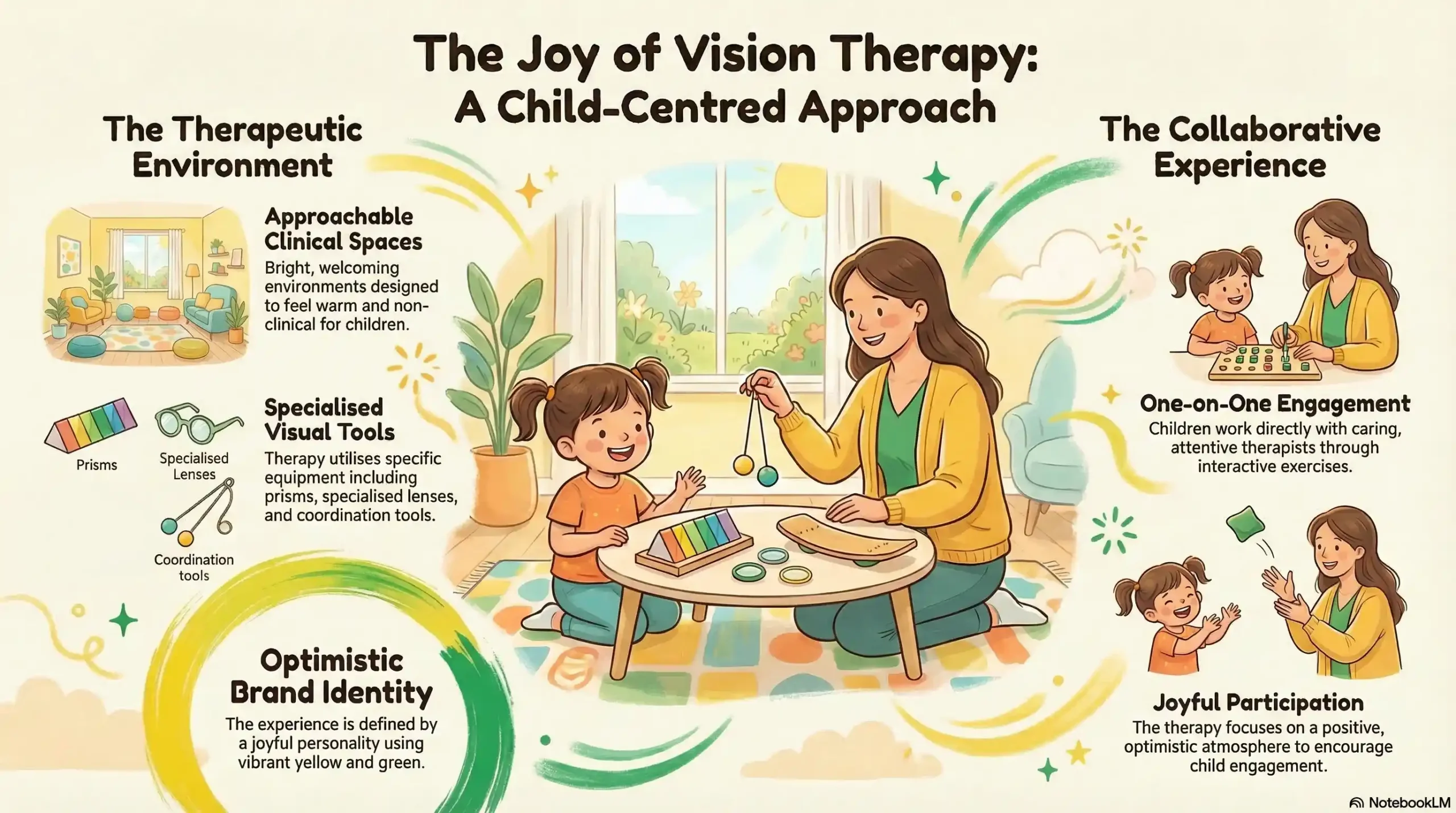
At Cook Vision Therapy Center, our programs are entirely patching-free and are built around a structured combination of supervised in-office sessions and targeted at-home exercises. This collaborative model — where the patient is an active, committed partner in their own progress — consistently produces the kind of lasting, functional improvements that change lives.
| Treatment Approach | Method | Addresses Binocular Vision? | Patching Required? |
|---|---|---|---|
| Eye Patching (Traditional) | Covers strong eye to force weak eye to work | ❌ Limited | ✅ Yes |
| Atropine Eye Drops | Blurs strong eye with medication | ❌ Limited | ❌ No |
| Vision Therapy — Cook Method | Active brain-eye coordination training | ✅ Yes — Core Focus | ❌ No |
Patching-Free Lazy Eye Treatment in Marietta, GA — The Cook Vision Therapy Approach
When other approaches have fallen short — or when you are simply looking for the most expert, compassionate, and effective path forward — Cook Vision Therapy Center is where patients across Metro Atlanta, the Southeast, and beyond come for answers.
Dr. David L. Cook, O.D., F.A.A.O., F.C.O.V.D. is an internationally recognized clinician, author, and educator with over forty years of dedicated experience in vision therapy and visual performance care. His published works — Visual Fitness and When Your Child Struggles — are trusted resources for patients and professionals alike. Alongside Dr. Cook, Dr. Ekta Patel, B.Optom, O.D. brings additional clinical depth to the practice, ensuring every patient receives thoughtful, individualized attention.
The Cook Vision Therapy approach begins with a comprehensive Vision Therapy Evaluation — a thorough diagnostic process designed to identify not just the presence of amblyopia, but its type, severity, and interaction with any related visual conditions. This evaluation forms the foundation of a personalized treatment plan tailored specifically to each patient’s unique visual profile and life goals.
From there, treatment unfolds as a structured, collaborative journey: supervised in-office therapy sessions combined with targeted at-home exercises. Patients are active partners in their progress — and that partnership is one of the strongest predictors of life-changing results.
Cook Vision Therapy Center proudly serves patients from Marietta, Kennesaw, Roswell, Smyrna, Midtown Atlanta, and Duluth, and communities throughout the Southeast, including Chattanooga, Birmingham, and Charleston. For patients who cannot travel regularly, personalized distance vision therapy programs are available following an initial in-person evaluation, making world-class care accessible regardless of location.
Take the first step today. Call (770) 419-0400 to schedule your Vision Therapy Evaluation at our Marietta, GA office.
Signs Your Child — or You — May Have Amblyopia
Recognizing amblyopia early is one of the most powerful things a parent or individual can do. The signs are not always obvious — which is why so many cases go undetected until they begin affecting academic performance, daily function, or quality of life.
Use the following checklist as a starting point. If you recognize several of these signs in your child or yourself, a comprehensive vision therapy evaluation is strongly recommended.
| Signs in Children | Signs in Adults |
|---|---|
| Struggles to read or write despite being bright | Difficulty judging distances or depth |
| Frequently closes or covers one eye | Persistent headaches or visual fatigue |
| Tilts head to one side when focusing | Challenges with night driving |
| Poor fine motor skills or coordination | Reduced or absent depth perception |
| Writes letters or words in reverse | Long history of lazy eye never fully resolved |
| High frustration or emotional distress during homework | Avoidance of tasks requiring precise visual focus |
| Reluctance to be in photos | Poor performance in visually demanding work or sports |
If any of these signs resonate, please do not wait. Early action — or action at any stage — produces better outcomes than continued delay. Our team is here to help you understand exactly what is happening and what can be done about it.
Local Resources & Citations
1. Georgia Department of Public Health — Vision Screening Program The official state health authority overseeing Georgia’s mandated child vision screening requirements — check here to understand what screenings your child is entitled to through Georgia public schools and how to pursue further evaluation when a screening flags a concern.
2. Cobb County School District — Student Health Services The official health services division for Marietta and Cobb County public schools — reference this resource to understand vision-related support services, school nurse referral protocols, and how a vision therapy diagnosis can be communicated to your child’s educational team.
3. National Eye Institute (NEI) — National Institutes of Health (.gov) The U.S. government’s leading federally funded eye research institute — reference this page for clinically reviewed, evidence-based information on amblyopia causes, prevalence, and treatment options as a complement to your specialist consultation.
4. American Optometric Association — Clinical Practice Guidelines The official national professional body governing optometric standards of care — reference this resource for the clinical framework and peer-reviewed treatment protocols that board-certified vision therapy specialists like Dr. Cook adhere to in designing amblyopia treatment programs.
Your Next Step — A Free Phone Consultation With Cook Vision Therapy
We understand that taking the first step toward a new specialist can feel daunting — especially if you or your child has already been through evaluations, prescriptions, or treatments that have not delivered the results you hoped for.
That is precisely why we offer a free phone consultation as your first, no-obligation step. There is no pressure to commit to anything. Our goal is simply to listen to your concerns, answer your questions, and help you understand whether vision therapy is the right path forward for your situation.
From there, a comprehensive Vision Therapy Evaluation will give us the full clinical picture we need to design a personalized, effective treatment program — one built specifically around your child’s needs or your own visual goals.
Whether you are located in Marietta, anywhere in Metro Atlanta, or across the Southeast, we are here to help.
📍 1395 South Marietta Pkwy SE, Bldg 400, Ste 107, Marietta, GA 30067 📞 (770) 419-0400 🌐 cookvisiontherapy.com
Proudly serving Marietta, Kennesaw, Roswell, Smyrna, Midtown Atlanta, Duluth, and patients across the Southeast United States.
Call (770) 419-0400 today to schedule your free phone consultation. Your journey to restored visual performance starts with a single call.
Frequently Asked Questions
-
Yes. Contrary to a widely held but outdated belief, lazy eye (amblyopia) can be treated in adults. The brain retains a degree of neuroplasticity — the ability to form new neural connections — throughout life. While adult treatment timelines are typically longer than those for children, meaningful improvements in visual acuity, depth perception, 3D vision, and daily function are achievable at any age with a properly designed vision therapy program.
At Cook Vision Therapy Center in Marietta, GA, Dr. David L. Cook has successfully worked with adult amblyopia patients for over forty years. If you have been told it is too late to treat your lazy eye, we encourage you to call (770) 419-0400) for a free phone consultation and get a second opinion from a specialist.
Disclaimer
This content is for informational purposes only and does not constitute medical advice, diagnosis, or treatment. Always consult a qualified eye care professional regarding any concerns about Amblyopia or other vision conditions. Individual treatment timelines and outcomes may vary.