Vision Therapy and Learning Differences
What Parents Need to Know
When a bright child struggles to read, loses their place on the page, or melts down over homework, parents often hear the same explanations: dyslexia, ADHD, or a learning disability. But for a meaningful number of children, an undetected learning-related vision problem is quietly making everything harder. Understanding the real connection between vision therapy and learning differences can help you find the right help faster, instead of watching your child fall further behind.
Key Takeaways
- Vision and learning are deeply connected. The American Optometric Association estimates that roughly 80% of learning happens through visual pathways, and about 1 in 4 children has a vision problem significant enough to affect learning.
- Vision therapy treats vision problems, not learning disabilities themselves. It does not cure dyslexia or ADHD, but it can address functional vision issues that coexist with, or are mistaken for, those conditions.
- Convergence insufficiency and other eye-teaming problems can mimic the inattention and reading struggles seen in ADHD and dyslexia.
- A standard 20/20 eye exam is not enough to catch these problems; a comprehensive developmental vision evaluation is needed.
- Early, accurate diagnosis matters. Identifying a vision component early can spare a child years of frustration and protect their self-esteem.
Vision Therapy and Learning Differences
Vision therapy is a supervised program of eye exercises designed to improve visual skills and brain-eye coordination, helping with a variety of developmental delays like autism or learning disabilities

Dyslexia
Vision therapy offers a promising avenue for improving visual processing and related skills, thereby easing some of the difficulties associated with dyslexia.
Attention Deficits
Vision problems can masquerade as attention problems or make true attention problems worse.

Autism Spectrum
We use a neurodevelopmental approach to strengthen 7 core visual abilities, helping individuals process sensory input more comfortably.

Developmental Disorders
Vision therapy can improve many visual dysfunctions related to developmental disorders, but effectiveness depends on individual evaluation and commitment to therapy
The Link Between Vision and Learning
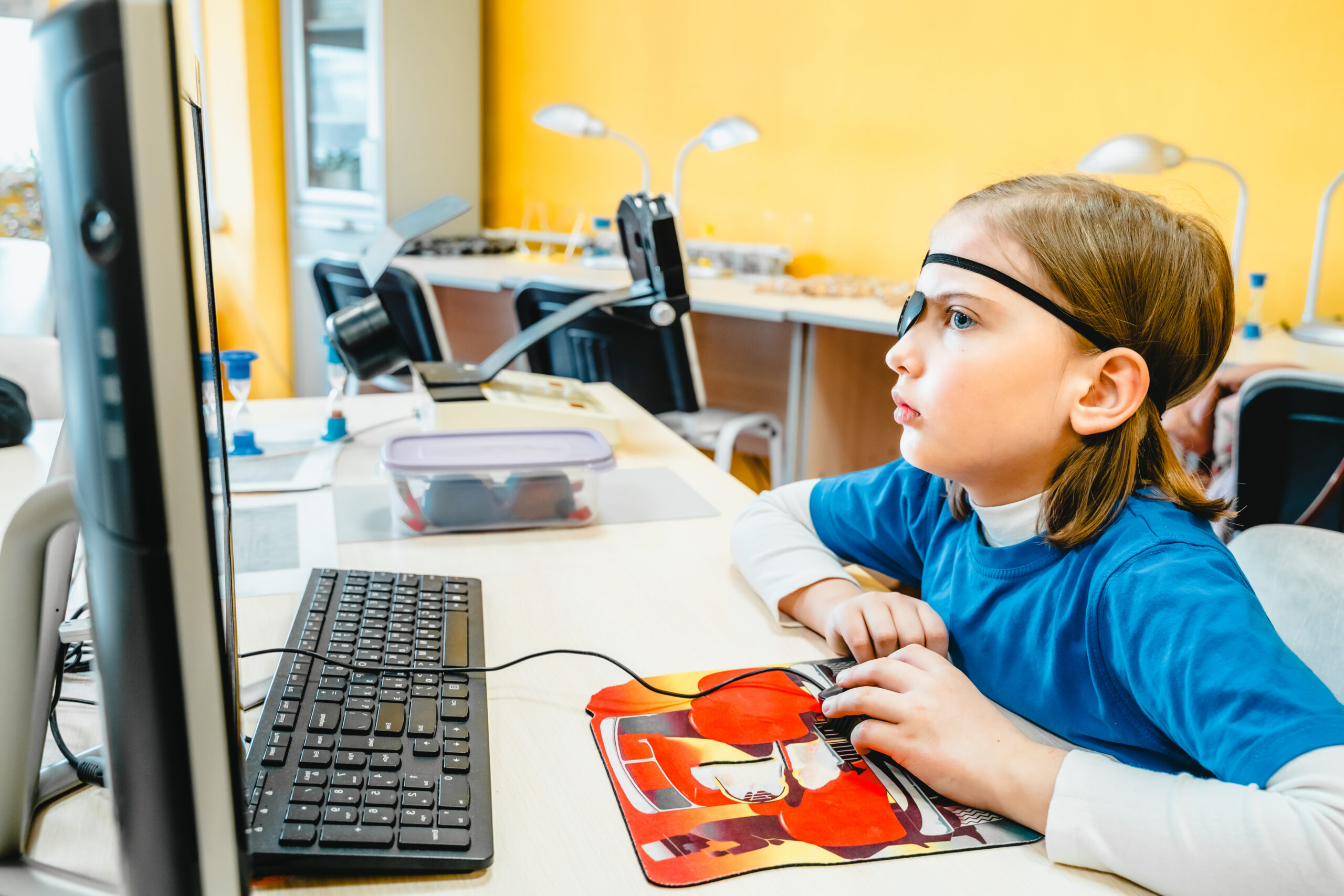
Most parents think of vision as simply seeing clearly across a room. In reality, reading and learning depend on a much more sophisticated set of skills. Researchers point to 17 distinct visual skills the brain must coordinate to read efficiently, including eye tracking, eye teaming, focusing, and visual processing. When any of these break down, a child can have perfect 20/20 eyesight and still struggle every time they open a book.
The scope of this issue is larger than most families realize. According to the American Optometric Association, up to 80% of learning comes through the visual pathways, and roughly 25% of school-age children have a vision problem significant enough to impact their learning (American Optometric Association). These are not children who need stronger glasses. They are children whose eyes are not working together the way reading demands.
This is the heart of the connection between learning disabilities and vision. A child can be intelligent, motivated, and well-supported at home and still fall behind because the physical act of reading is exhausting and inconsistent. When that happens, the problem is often blamed on effort or intelligence when the real issue lives in how the eyes and brain coordinate.
Learning Differences vs. Learning-Related Vision Problems
It is important to be precise here, because precision is what helps families make good decisions. A learning difference and a learning-related vision problem are not the same thing, even though they can look identical from the outside.
A learning disability such as dyslexia is, at its core, a language-processing difference. ADHD is a difference in attention regulation. Neither is caused by the eyes. A learning-related vision problem, by contrast, is a functional issue with how the eyes move, focus, and work as a team. Examples include convergence insufficiency, eye-tracking deficits, and focusing problems.
Here is why this distinction matters: a child can have a learning difference, a vision problem, or both at the same time. When a vision problem goes undetected, it can magnify the symptoms of an existing learning difference, making reading even harder than the underlying condition alone would. Vision therapy treats the vision component. It does not replace reading instruction, tutoring, or other support a child may need for a true learning disability. The goal is to remove the visual roadblocks so that other interventions can actually work.
Vision Therapy for Dyslexia: Setting the Record Straight

Few topics generate more confusion than dyslexia and vision therapy, so let us be direct. Vision therapy is not a treatment for dyslexia itself.
Dyslexia is a language-based difference that affects how the brain decodes and sounds out letters, not how the eyes see them. Reputable organizations, including the American Academy of Pediatrics and the American Academy of Ophthalmology, have stated that vision therapy is not a cure for dyslexia, and an honest provider will tell you the same (Understood.org).

So where does vision therapy fit in?
Many children diagnosed with dyslexia also have an underlying functional vision problem such as convergence insufficiency. When the eyes cannot comfortably work together at near distances, words blur, double, or swim on the page, which makes the decoding work of dyslexia even more frustrating.
In these cases, treating the coexisting vision problem can make reading more comfortable, reduce fatigue, and allow specialized reading instruction to take hold.
The honest takeaway:
If your child has dyslexia, they still need evidence-based reading support. But if a vision problem is layered on top, addressing it can remove a real obstacle that has been holding your child back. A thorough evaluation is the only way to know whether that vision component exists.
Signs Your Child May Have a Learning-Related Vision Problem
Because these problems hide behind everyday behavior, it helps to know what to watch for. Consider a vision evaluation if your child regularly shows several of the following:
A single symptom is not cause for alarm, but a cluster of them is worth investigating. Importantly, a school vision screening or a standard eye exam can easily miss these issues because they primarily test distance acuity, not the eye-teaming and focusing skills reading requires.
What to Expect at Cook Vision Therapy Center

Families across Georgia, the Southeast, and the country come to Cook Vision Therapy Center in Marietta, GA because of a simple promise: understand exactly how vision is affecting your child’s life, then tailor the right therapy to their unique challenges and goals.
Our founder, Dr. David Cook, is an internationally recognized clinician, author, and educator with more than 40 years of experience in vision therapy. He is joined by Dr. Ekta Patel, who graduated first in her class with highest honors.
Frequently Asked Questions
-
Is vision therapy backed by science?
Yes, for specific diagnoses. The Convergence Insufficiency Treatment Trial, a major clinical study, found that office-based vision therapy with home reinforcement was effective for convergence insufficiency. Vision therapy is not, however, a scientifically supported treatment for dyslexia or ADHD as conditions in themselves.
-
How long does a vision therapy program take?
-
Will my child still need tutoring or reading support?
-
Does insurance cover vision therapy?
-
My child passed the school vision screening. Could they still have a problem?
-
At what age can a child start vision therapy?
Check Out Our Resources
Dr. Cook’s Publications:
- Authored books VISUAL FITNESS and WHEN YOUR CHILD STRUGGLES.
- Published articles in top optometric journals.
- His article “Eyesight, infinity and the human heart” was voted “Best Non-Technical Article” by the Association of Optometric Editors.
When Your Child Struggles

Visual Fitness