Helping Your Child See, Learn, and Thrive
Pediatric Vision Therapy in Atlanta
One in four children has a vision problem significant enough to affect learning, yet most will pass a school screening with flying colors. If your child is struggling with reading, homework, or attention, their eyes may be sending the wrong signals to their brain. Cook Vision Therapy Center in Marietta, GA, has spent over 40 years helping Atlanta-area families uncover and treat the hidden vision problems behind these struggles.
Key Takeaways
- Over 25% of children have a vision problem that glasses alone cannot fix, and standard school screenings miss most of them
- Up to 80% of classroom learning depends on the visual system, making undetected vision dysfunction a serious academic barrier
- The NEI-funded CITT study found that office-based vision therapy produced significant improvement in 73% of children with convergence insufficiency
- Vision therapy retrains the brain-eye connection through individualized, supervised programs designed for each child’s needs
- Cook Vision Therapy Center in Marietta, GA offers specialized pediatric expertise from Dr. David Cook (FAAO, FCOVD) with over four decades of clinical experience
Signs Your Child May Need Vision Therapy
Children rarely complain about vision problems because they have no frame of reference for “normal” seeing. A child who has always seen double print assumes everyone does. That silence makes it critical for parents to watch for behavioral clues:
- Frequent headaches or eye pain during reading and homework
- Skipping lines, losing their place, or using a finger to track while reading
- Reading below grade level despite strong intelligence
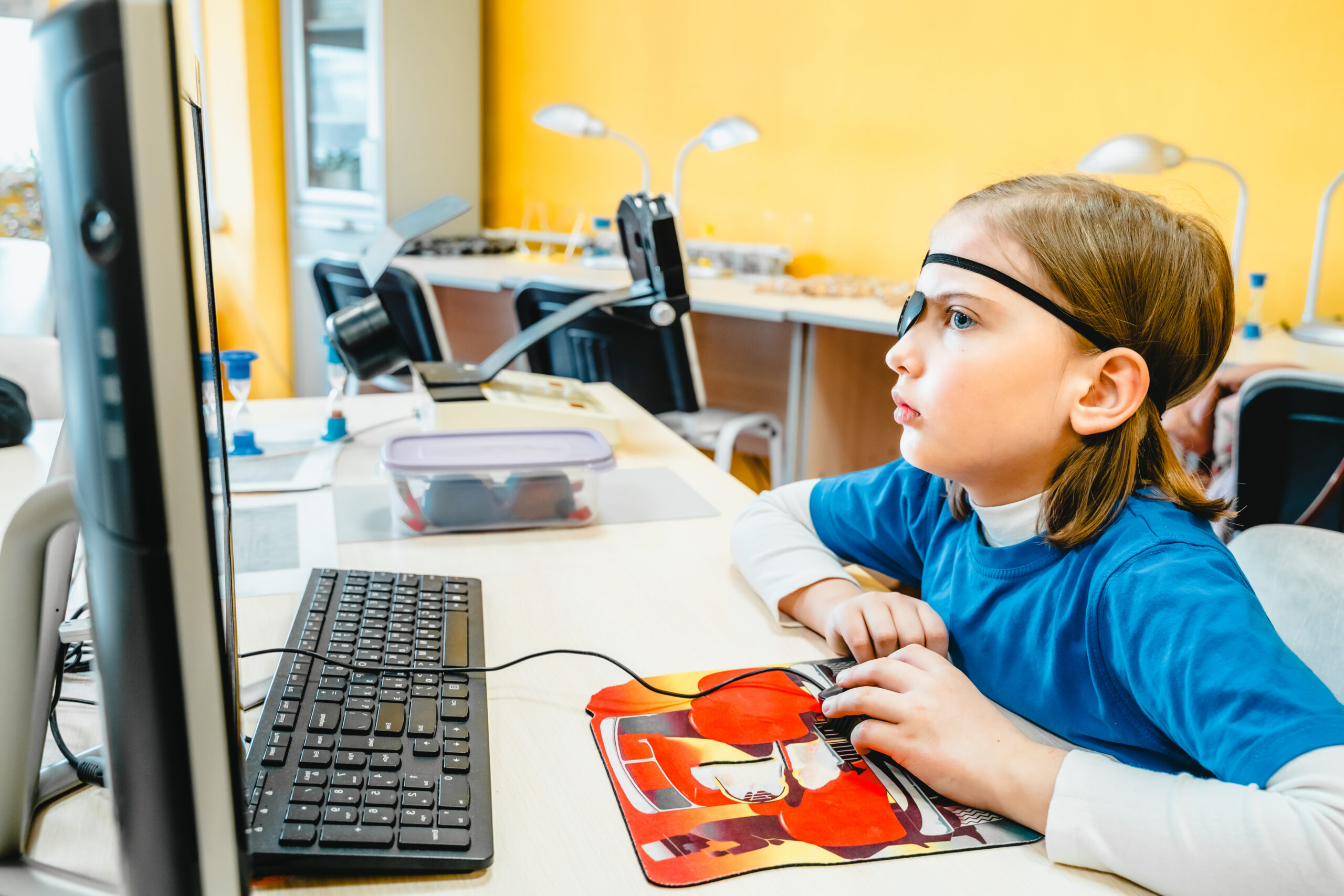
- Closing or covering one eye during close-up tasks
- Short attention span during visual work (often mistaken for ADHD)
- Reversing letters or numbers beyond age seven
- Difficulty catching balls or poor coordination in sports
- Tilting the head while reading or doing near work
- Complaints that words look blurry, doubled, or “moving”
- Avoidance of homework, reading, or any close-up activity
The last point deserves emphasis. When a child fights homework every night, parents and teachers often chalk it up to laziness or behavioral issues. But a child whose eyes physically cannot sustain focus on a page for more than a few minutes is not being defiant. They are exhausted. Recognizing that pattern can change everything about how you approach your child’s struggles.
Conditions Pediatric Vision Therapy Treats
The range of visual conditions that respond to pediatric vision therapy is broader than most parents realize.
1. Convergence insufficiency
Convergence insufficiency is among the most common and most studied. It occurs when a child’s eyes struggle to coordinate inward for near-work tasks like reading and writing. Symptoms include headaches, blurred text, loss of concentration, and an inability to read for more than a few minutes. The National Eye Institute funded the Convergence Insufficiency Treatment Trial (CITT), a landmark study that found office-based vision therapy produced significant symptom improvement in 73% of participating children, far outperforming home-based exercises and pencil push-ups.
2. Amblyopia
Amblyopia(lazy eye) has traditionally been treated with patching, but modern developmental optometry offers a different path. Vision therapy programs for amblyopia use binocular techniques that train both eyes to work as a team, often producing stronger, more lasting results than patching alone. This approach is less frustrating for children and more likely to develop true three-dimensional vision.
3. Strabismus
Strabismus (eye turns or crossed eyes) affects how the eyes align, and vision therapy can improve coordination and binocular function, sometimes reducing or eliminating the need for surgery. Saccadic dysfunction (eye tracking problems) makes it physically difficult for a child to move their eyes smoothly across a line of text, directly undermining reading fluency. Accommodative dysfunction (focusing problems) leaves children unable to shift focus efficiently between distances, a skill they need dozens of times per hour in a classroom.
4. Visual processing disorders
Visual processing disordersaffect how the brain interprets what the eyes see. These conditions are closely linked to reading difficulties and dyslexia, and they can make a bright child appear to struggle academically. Similarly, some children diagnosed with attention deficits actually have an underlying vision problem driving their inability to sustain focus on visual tasks. When the visual system is overtaxed, attention fractures. Treating the vision problem often resolves what looked like an attention disorder.
5. Concussions
Young athletes recovering from concussions represent another important group. Post-concussion vision problems in children can include light sensitivity, difficulty tracking moving objects, balance issues, and reading problems that linger long after other symptoms clear. Targeted neuro-optometric rehabilitation can help restore these visual skills.
The Evidence Behind Pediatric Vision Therapy
Parents considering vision therapy deserve to know that this treatment stands on solid scientific ground. The most important piece of evidence is the Convergence Insufficiency Treatment Trial (CITT), a multi-site, randomized clinical trial funded by the National Eye Institute. The study specifically enrolled children aged 9 to 17 and compared four treatment approaches.
Beyond convergence insufficiency, developmental optometry standards set by the COVD provide clinical frameworks for treating the full spectrum of binocular vision and visual processing disorders in children. The Cleveland Clinic recognizes vision therapy as an established treatment for binocular vision disorders.
The research is clear: when a child’s visual system is not functioning properly, structured, supervised vision therapy can make a measurable difference. This is not alternative medicine. It is evidence-based neuro-optometric care.
Office-based vision therapy with home reinforcement was the clear winner, producing successful or improved outcomes in approximately 73% of children, significantly better than home-based exercises, computer-based therapy, or placebo.
Why Atlanta Families Choose Cook Vision Therapy Center
Dr. David Cook has devoted more than 40 years to pediatric and developmental vision therapy. He is a Fellow of the American Academy of Optometry (FAAO) and a Fellow of the College of Optometrists in Vision Development (FCOVD), credentials that place him among the most qualified vision therapy providers in the country. He is internationally recognized for his expertise, having trained other optometrists around the world in his approach.
Dr. Ekta Patel (B.Optom, O.D.) brings additional clinical depth to the team, ensuring thorough, collaborative care for every child.


Located in Marietta, GA, Cook Vision Therapy Center serves families throughout metro Atlanta, across Georgia, and from the Southeast and beyond. Families travel considerable distances to access this level of specialized care. That speaks to something important: the provider you choose for your child’s vision therapy matters enormously. Dr. Cook’s philosophy centers on finding the “exact mix of procedures” that will change a child’s visual abilities for the long term, not a one-size-fits-all protocol.
If your child is struggling and you suspect vision may be part of the picture, take the first step. Schedule a vision therapy evaluation by calling (770) 419-0400 or visiting the website. Understanding your child’s visual system is the foundation for helping them succeed.
What People are Saying
Frequently Asked Questions About Pediatric Vision Therapy
-
What is the best age to start pediatric vision therapy?
Children as young as four or five can begin vision therapy when a developmental vision problem is identified. There is no single “ideal” age because the right time depends on the specific condition and the child’s developmental readiness. That said, earlier intervention generally means less time for compensatory habits to become entrenched. If you notice signs at any age, a comprehensive evaluation is the best next step. Call Cook Vision Therapy Center at (770) 419-0400 to discuss your child’s situation.
-
Does insurance cover pediatric vision therapy?
-
What if my child won't cooperate during sessions?
-
How is vision therapy different from occupational therapy?
-
Can vision therapy replace glasses for my child?
Check Out Our Resources
Dr. Cook’s Publications:
- Authored books VISUAL FITNESS and WHEN YOUR CHILD STRUGGLES.
- Published articles in top optometric journals.
- His article “Eyesight, infinity and the human heart” was voted “Best Non-Technical Article” by the Association of Optometric Editors.
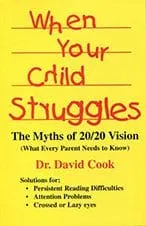
When Your Child Struggles

Visual Fitness