Do Lazy Eye Games Really Work? What Marietta Parents Need to Know
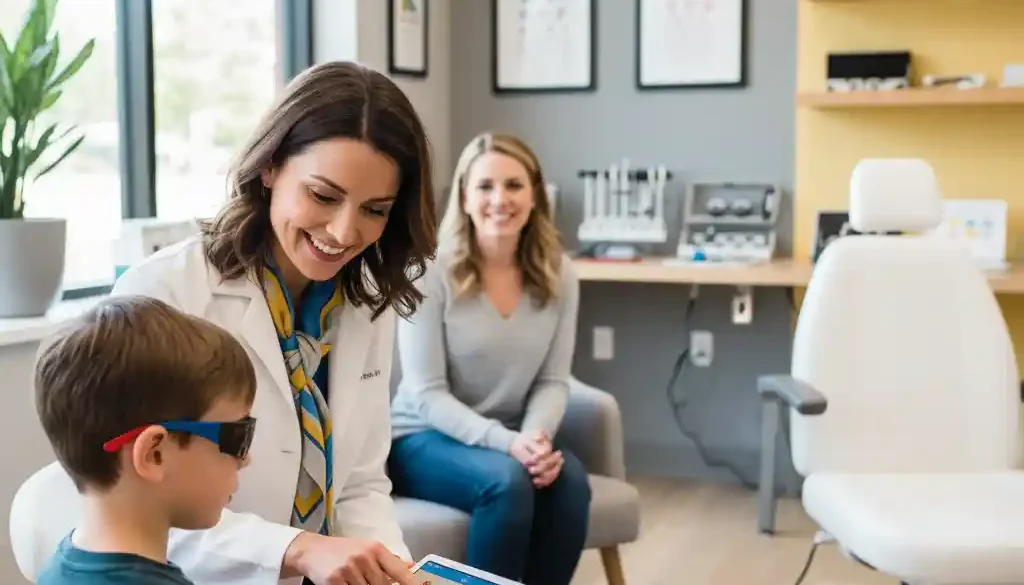
Lazy eye games and apps can provide mild visual stimulation, but they are not a substitute for supervised vision therapy. Clinical research shows that structured, personalized vision therapy — which trains both eyes to work together — produces measurably superior, lasting results for amblyopia in both children and adults compared to unsupervised game-based approaches alone.
If you’ve recently typed “lazy eye games” into a search bar at 11 p.m. while your child sleeps, you are not alone. Every day, parents across Marietta, Kennesaw, Roswell, and greater Metro Atlanta discover a world of apps, digital games, and eye patches promising to fix their child’s amblyopia — and they wonder: could it really be this simple?
The honest answer is nuanced — and it matters enormously for your child’s long-term visual health. Some game-based tools have a legitimate scientific basis. Others are little more than digital distractions marketed as medical solutions. And none of them, used alone, can replicate what a comprehensive, clinician-supervised vision therapy program delivers.
In this guide, Dr. David L. Cook, O.D. — an internationally recognized vision therapy specialist with over 40 years of experience serving Metro Atlanta families — breaks down the science, the limitations, and the proven path to lasting results for lazy eye treatment in Marietta, GA.
What Is a Lazy Eye, Really? Understanding Amblyopia
The term “lazy eye” is one of the most misunderstood phrases in children’s healthcare. Many parents picture an eye that simply needs to be “woken up” or exercised — which is part of why games seem like such an appealing solution. But the reality is considerably more complex.
Amblyopia is not a problem with the eye itself. It is a neurodevelopmental condition rooted in the brain. When one eye sends a weaker or distorted signal, the brain — in an act of self-preservation — learns to suppress that signal and rely almost entirely on the stronger eye. Over time, the neural pathways connecting the weaker eye to the visual cortex become underdeveloped. The eye is not lazy. The brain has simply stopped fully listening to it.
This distinction is critical. It means that treatment must target the brain’s visual processing system — not just the eye — to produce real, lasting improvement.
Why the Brain — Not Just the Eye — Is the Real Problem
Think of it this way: if a muscle in your arm stops receiving nerve signals properly, simply moving the arm won’t rebuild the connection. You need targeted neurological rehabilitation. Amblyopia works on a similar principle.
The visual cortex — the part of the brain responsible for interpreting what your eyes see — must be retrained to accept, process, and integrate input from both eyes simultaneously. This requires structured, progressive stimulation under clinical guidance. It is not something a downloaded app can reliably achieve on its own.
Common Signs Your Child May Have Amblyopia
Many children with amblyopia have no idea anything is wrong — they have never experienced clear binocular vision, so they have no reference point. Parents are often the first to notice something is off. Watch for these signs:

| Sign | What It Looks Like | Why It Matters |
|---|---|---|
| Squinting or closing one eye | Child squints in bright light or when focusing | May indicate suppression of weaker eye |
| Head tilting | Consistently tilts head to one side | Compensating for misaligned visual input |
| Covering one eye | Covers eye during reading or screen time | Avoiding double vision or blur |
| Struggles with reading | Loses place, skips words, reads slowly | Visual processing inefficiency |
| Poor depth perception | Misjudges distances, clumsy in sports | Binocular vision deficit |
| Visible eye misalignment | One eye drifts inward or outward | Classic strabismic amblyopia presentation |
| Avoids close work | Resists homework, drawing, puzzles | Visual fatigue and discomfort |
If your child shows two or more of these signs consistently, a comprehensive Vision Therapy Evaluation — not a standard eye chart exam — is the appropriate next step.
So, Do Lazy Eye Games Actually Work?
This is the question at the heart of every late-night parent search — and it deserves a direct, honest answer. The short version: game-based tools for amblyopia have a real scientific foundation, but their effectiveness as a standalone treatment is significantly limited. Here is what the research actually shows.
The Science Behind Vision-Based Games for Amblyopia
The most credible game-based approaches for lazy eye treatment are built on a concept called dichoptic therapy. Dichoptic therapy works by presenting different visual information to each eye simultaneously — typically using special glasses — forcing the brain to use both eyes together rather than suppressing one. When designed correctly, this approach can stimulate the visual cortex and encourage binocular integration.
Research published in clinical vision science journals has shown that dichoptic game-based interventions can produce measurable improvements in visual acuity for some patients, particularly children. This is genuinely promising science, and it forms a legitimate part of the evolving amblyopia treatment landscape.
What Games Can Do — And What They Cannot
Understanding the boundaries of game-based tools is essential before making any treatment decision for your child.
Games that incorporate dichoptic principles can provide useful visual cortex stimulation. They can make therapy feel engaging and reduce resistance in children who struggle with traditional patching. When used as a component of a supervised program, they can support progress.
However, games used as a standalone solution cannot diagnose the specific type or severity of amblyopia your child has. They cannot assess whether underlying binocular vision deficits — such as convergence insufficiency or eye teaming problems — are compounding the condition. They cannot adapt in real time to your child’s neurological response the way a trained clinician can. And critically, they cannot prevent “false progress” — the appearance of improvement on a simple acuity test that masks deeper binocular dysfunction that will resurface later.
The Critical Difference: A Game vs. A Therapy Program
Consider this analogy. If you tore a ligament in your knee, a fitness app with leg exercises might help you feel stronger. But no physical therapist would consider that app a substitute for a structured rehabilitation program. The exercises matter — but so does the clinical eye guiding the protocol, measuring your response, and adjusting the plan when you plateau.
Supervised vision therapy operates on the same principle. The exercises and activities — including technology-based tools — are powerful when embedded in a personalized, progressive program designed and monitored by a specialist. Removed from that clinical framework, they are simply exercises without direction.
📞 Wondering if your child’s lazy eye can be treated without patching? Call Cook Vision Therapy Center in Marietta, GA for a Free Phone Consultation: (770) 419-0400
What Makes Vision Therapy Different From a Lazy Eye Game?
At Cook Vision Therapy Center in Marietta, GA, amblyopia treatment is never a one-size-fits-all protocol. It begins with understanding the full picture of how your child’s visual system is functioning — not just how clearly each eye sees on a standard chart.
It Starts With a Comprehensive Vision Therapy Evaluation
A comprehensive Vision Therapy Evaluation at Cook Vision Therapy Center goes far beyond the standard “read the letters” assessment most families are accustomed to. Dr. Cook and his team assess binocular function — how well both eyes work together as a team. They evaluate eye tracking, focusing flexibility, depth perception, and the brain’s ability to process and interpret visual information accurately.
This evaluation produces a detailed, individualized understanding of your child’s visual system. It identifies not just the presence of amblyopia but its underlying cause — whether strabismic, refractive, or deprivational — and any co-existing conditions that must be addressed for treatment to succeed. This diagnostic precision is the foundation of a therapy plan that actually works.
A Patching-Free Approach That Trains Both Eyes Together
One of the most common fears parents bring to their first consultation is the prospect of patching. The idea of covering their child’s stronger eye for hours each day — dealing with resistance, tears, and the social difficulty it creates at school — is deeply stressful. Many families have already tried patching with limited success or significant emotional cost.
Cook Vision Therapy Center’s approach to amblyopia treatment is built on a fundamentally different philosophy: train both eyes to work together, rather than forcing reliance on one. This patching-free methodology uses structured binocular activities and advanced vision therapy techniques to rebuild the brain’s ability to integrate input from both eyes simultaneously. The goal is not just improved acuity in the weaker eye — it is genuine, functional binocular vision that supports reading, learning, sports, and daily life.
In-Office Sessions + At-Home Exercises = Real Progress
Vision therapy at Cook Vision Therapy Center is a collaborative process. Patients engage in regular in-office sessions using specialized equipment, guided by the clinical team. Between sessions, structured at-home activities reinforce and accelerate progress — think of them as the “homework” that makes the in-office work stick.
This is meaningfully different from downloading an app and hoping for the best. Every element of the program is calibrated to the patient’s current level of progress, adjusted as they improve, and tracked with clinical precision. Families consistently report that this structured, supported process produces results that previous attempts — including patching and generic exercises — never achieved.

| Feature | Lazy Eye Game / App | Cook Vision Therapy Program |
|---|---|---|
| Personalized to your child | ❌ Generic protocol | ✅ Custom evaluation & plan |
| Clinician supervised | ❌ Self-directed | ✅ Dr. Cook & team |
| Treats root cause | ❌ Surface stimulation | ✅ Binocular retraining |
| Patching-free | ⚠️ Varies | ✅ Yes |
| Measurable progress | ❌ No clinical tracking | ✅ Regular assessments |
| Works for adults too | ❌ Mostly child-focused | ✅ All ages |
| Proven outcomes | ⚠️ Limited studies | ✅ 40+ years of results |
Can Adults Really Benefit From Lazy Eye Treatment?
One of the most persistent — and most harmful — myths in vision care is that amblyopia can only be treated in young children, and that adults who were not treated early are simply out of options. This belief has caused countless adults to accept a reduced quality of vision as permanent when it does not have to be.
The Neuroplasticity Advantage — It’s Not Too Late
Modern neuroscience has fundamentally revised our understanding of the adult brain’s capacity for change. The concept of neuroplasticity — the brain’s ability to reorganize and form new neural connections throughout life — has opened the door to effective amblyopia treatment well beyond childhood.
At Cook Vision Therapy Center, adults have experienced meaningful improvements in visual acuity, depth perception, and binocular function through structured vision therapy programs. The treatment timeline and approach may differ from a child’s program, but the neurological mechanisms that make therapy effective are not switched off at age seven. Adults who were told “it’s too late” are routinely discovering that the door to better vision was never fully closed — it simply required the right clinician to open it.
Why Marietta & Metro Atlanta Families Choose Cook Vision Therapy Center
Families across Metro Atlanta — from Marietta and Kennesaw to Roswell, Midtown, and Duluth — choose Cook Vision Therapy Center because they want more than a treatment. They want a transformation. And they want it delivered by someone with the credentials, experience, and genuine commitment to make it happen.
40+ Years of Experience. Thousands of Patients. Life-Changing Results.
Dr. David L. Cook, O.D., F.A.A.O., F.C.O.V.D. is an internationally recognized clinician, educator, and author whose career spans more than four decades of specialized vision therapy practice. He is the author of Visual Fitness and When Your Child Struggles — published resources that have guided parents and professionals across the country in understanding the connection between vision and learning.
Dr. Cook and his team have helped thousands of patients — children struggling in school, adults frustrated by chronic symptoms, and individuals recovering from neurological events — achieve outcomes that other practitioners told them were not possible. This depth of experience means that when your child sits down for their first evaluation at Cook Vision Therapy Center, they are being assessed by a clinician who has seen and successfully treated virtually every presentation of amblyopia and related binocular vision disorders.
Distance Vision Therapy — Care That Comes to You
Cook Vision Therapy Center’s reputation extends far beyond Marietta, GA. Patients travel from across the Southeast — including Chattanooga, Birmingham, and Charleston — and from across the nation to receive care from Dr. Cook. For those who cannot make regular in-person visits, the practice offers personalized Distance Vision Therapy Programs, allowing patients to begin and maintain their therapy journey from home after an initial comprehensive evaluation. Elite vision therapy care is no longer limited by geography.
📍 Ready to find out what’s really happening with your child’s vision? Schedule a Vision Therapy Evaluation at Cook Vision Therapy Center. Located at 1395 South Marietta Pkwy SE, Bldg 400, Ste 107, Marietta, GA 30067. Call (770) 419-0400 today.
What to Expect on Your First Visit to Cook Vision Therapy Center
We understand that taking the first step toward a new treatment can feel uncertain — especially if your family has already been through evaluations, prescriptions, or patching programs that did not deliver the results you hoped for. At Cook Vision Therapy Center, the process is designed to be clear, supportive, and entirely focused on your child’s — or your own — unique needs.
Your journey begins with a Free Phone Consultation, a no-pressure conversation that allows our team to understand your concerns, answer your questions, and help you determine whether a full Vision Therapy Evaluation is the right next step. There is no obligation and no clinical jargon — just a genuine conversation with a team that has heard your story before and knows how to help.
If you move forward with the comprehensive evaluation, our team will conduct a thorough assessment of every dimension of your visual function. From that assessment, we build a personalized therapy plan — one designed specifically for your visual profile, your lifestyle, and your goals. From that point forward, you are not a patient following a generic protocol. You are a partner in a carefully guided process aimed at achieving lasting, life-changing results.
🏛️ LOCAL RESOURCES & CITATIONS
1. National Eye Institute — Amblyopia Facts. NIH’s official patient resource on amblyopia diagnosis and treatment options — cite this to validate the clinical definition of lazy eye used in the article.
2. Georgia Department of Public Health — Vision Screening Program. The state agency overseeing Georgia’s mandatory child vision screening requirements — reference this to reinforce why early identification of amblyopia in Cobb County school-aged children matters.
3. Cobb County School District — Student Health Services. The official health services page for Marietta-area public schools — relevant for parents whose children have been flagged during a school vision screening and are now seeking specialist care.
4. American Optometric Association — Amblyopia Clinical Guidelines. The AOA’s evidence-based clinical reference on amblyopia — use this to support the article’s treatment claims and reinforce Dr. Cook’s recommendations with the profession’s own published standards.
See What’s Possible
Lazy eye games may have sparked your curiosity — and that curiosity brought you here. That is a good thing. It means you are advocating for your child’s vision, asking the right questions, and refusing to accept “wait and see” as an answer.
The path from a downloaded app to a life-changing outcome runs through one critical step: a comprehensive evaluation by a specialist who can see the full picture of how your visual system is functioning, and design a personalized program to transform it.
At Cook Vision Therapy Center in Marietta, GA, that step is closer than you think — and it starts with a single phone call.
🌟 Don’t let a lazy eye hold your child — or you — back any longer. Contact Cook Vision Therapy Center in Marietta, GA today. Call (770) 419-0400 or visit cookvisiontherapy.com to schedule your Free Phone Consultation.
Frequently Asked Questions
-
These games utilize dichoptic therapy by:
-
Showing separate images to each eye.
-
Forcing the brain to stop suppressing the weak eye.
-
Building binocular vision over time.
-