Apps vs. In-Office Vision Therapy: What Really Works?
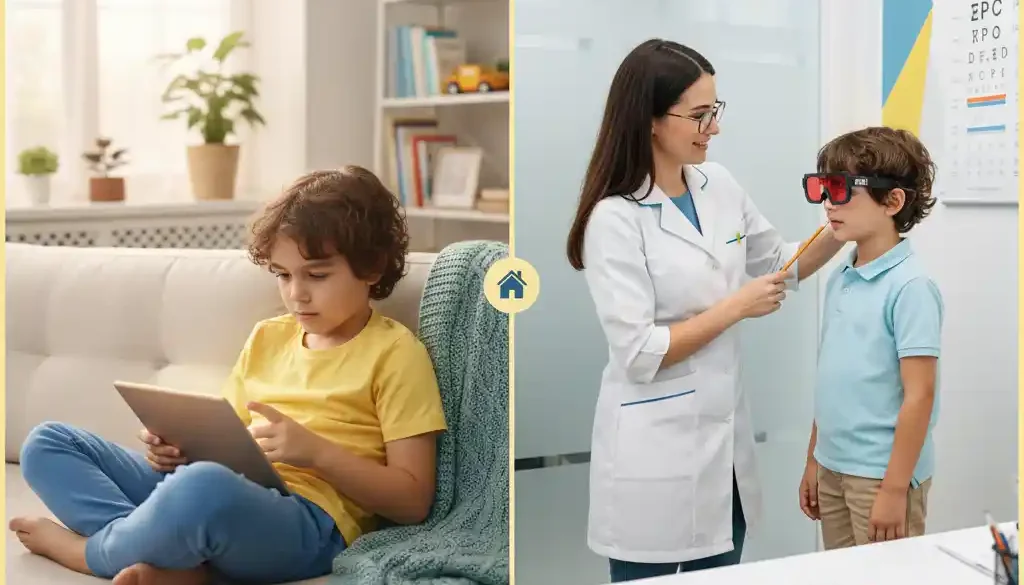
Vision therapy games and apps may offer limited benefits for mild visual tasks, but they cannot replicate the neurologically targeted, medically supervised results of in-office vision therapy. For conditions like convergence insufficiency, strabismus, amblyopia, or post-TBI rehabilitation, a personalized clinical program delivered by a certified specialist produces measurably superior, lasting outcomes.
If you have recently noticed your child tilting their head to read, covering one eye during homework, or becoming frustrated and emotional over schoolwork that should feel manageable, you are not alone. Across Marietta, Kennesaw, Roswell, and greater Metro Atlanta, parents are searching for answers. Many discover a growing marketplace of vision therapy apps and games that promise to correct lazy eye, improve reading, and sharpen focus — all from a smartphone or tablet, often for a fraction of the cost of clinical care.
The question every informed parent and patient deserves a clear answer to is this: do these digital tools actually work — and are they a safe substitute for supervised, in-office vision therapy?
At Cook Vision Therapy Center, Inc., located at 1395 South Marietta Pkwy SE, Bldg 400, Ste 107, Marietta, GA 30067, Dr. David L. Cook, O.D., F.A.A.O., F.C.O.V.D. and his team have spent over four decades answering exactly that question — one patient at a time. This guide will give you the clinically grounded, honest comparison you need to make the right decision for yourself or your child.
What Are Vision Therapy Games — And Why Are They Trending?
The rise of app-based vision tools is understandable. Digital health solutions have expanded rapidly across every area of medicine, and vision care is no exception. Programs like Amblyoplay, Vivid Vision, and RevitalVision market themselves as engaging, gamified alternatives to traditional clinical therapy — promising improvement in conditions ranging from amblyopia (lazy eye) to convergence insufficiency, delivered through colorful games played on a screen at home.
Their appeal is real. They are accessible, relatively affordable, and designed to feel engaging for children. For busy families in Cobb County navigating packed schedules, the idea of a therapeutic “game night” that doubles as medical treatment is genuinely attractive.
However, the critical distinction lies not in the delivery format — it lies in the diagnostic foundation, clinical supervision, and neurological precision behind the program. Vision therapy games are built around general visual stimulation. In-office vision therapy is built around your specific diagnosis.
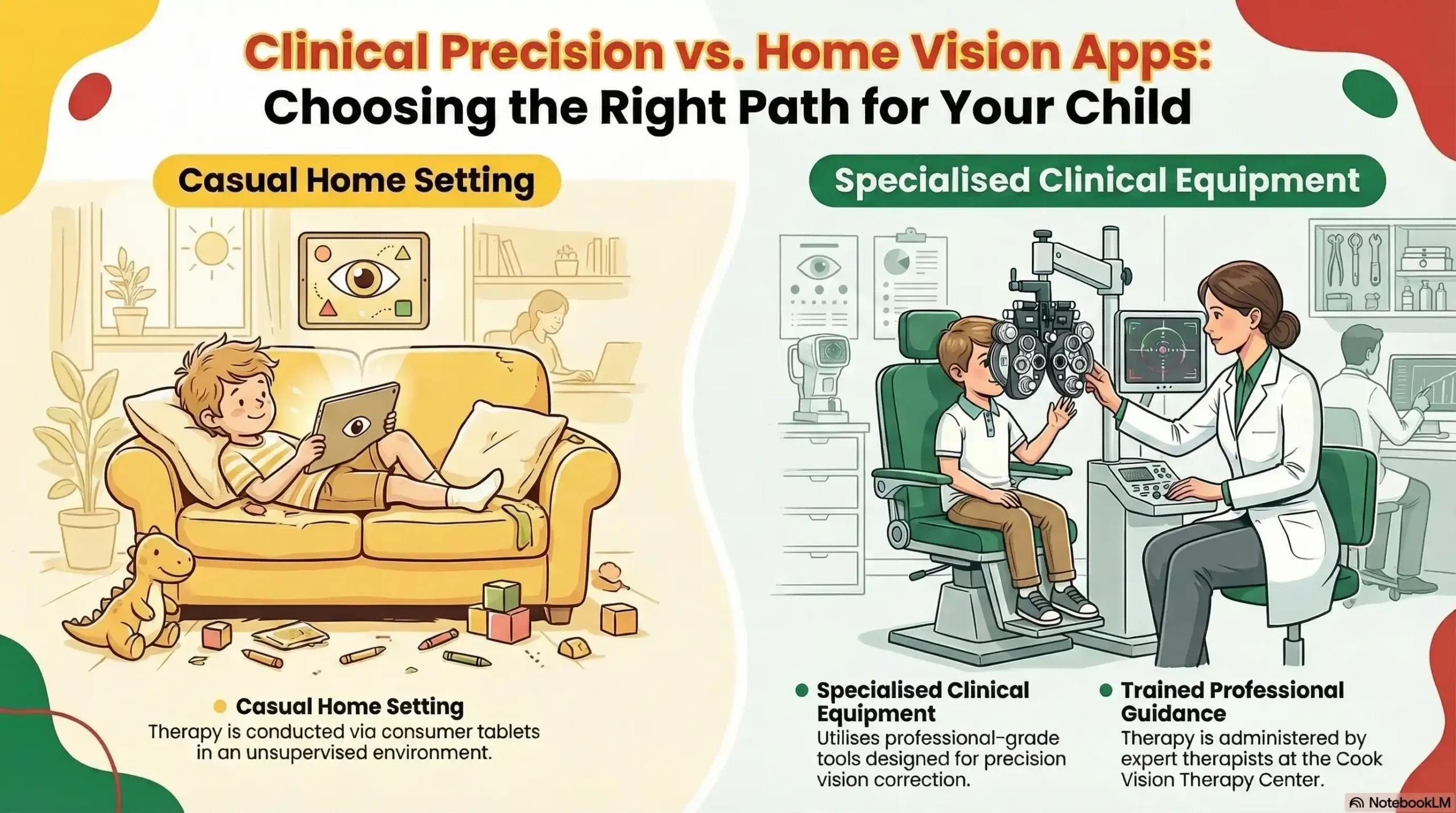
| Feature | Vision Therapy Games / Apps | In-Office Vision Therapy |
|---|---|---|
| Supervision | None — self-guided | Trained OD + vision therapist |
| Personalization | Generic program for all users | Custom-tailored to individual diagnosis |
| Conditions Addressed | Limited — primarily basic amblyopia | Full spectrum of binocular vision disorders |
| Equipment | Consumer screen or VR headset | Specialized clinical instruments |
| Medical Backing | Minimal peer-reviewed support | COVD-certified, evidence-based protocols |
| Suitability for TBI/Neuro | Not appropriate | Specifically designed for neuro-optometric rehab |
| Results | Inconsistent, limited documentation | Documented, lasting, life-changing outcomes |
How In-Office Vision Therapy Actually Works
It’s Not About Eyesight — It’s About How Your Eyes Work Together
One of the most important clarifications a specialist like Dr. Cook makes to new patients is this: vision therapy is not about correcting blurry eyesight. A child can have 20/20 acuity on a standard eye chart and still suffer significantly from convergence insufficiency, binocular vision dysfunction, or visual processing disorders that make reading, learning, and concentration genuinely difficult.
In-office vision therapy focuses on training the neuromuscular system — the complex relationship between the eyes, the brain, and the body. It addresses how the two eyes work together as a team, how the visual system tracks moving objects, how the brain processes and interprets what the eyes see, and how all of these functions integrate with attention, balance, and learning.
This is precisely why a generic app cannot replicate clinical therapy. An app does not know whether your child has a suppression pattern in one eye, a visual memory deficit compounding a reading challenge, or a binocular coordination problem affecting attention span. A certified vision therapist — working under the direct supervision of Dr. Cook — does.
What Happens During a Vision Therapy Session?
Each in-office session at Cook Vision Therapy Center is a structured, purposeful clinical encounter. Patients engage in a carefully sequenced series of activities and exercises using specialized therapeutic equipment — including prisms, lenses, filters, balance boards, and computerized vision training systems — selected specifically for their diagnosed condition and current progress.
Sessions typically last 45 to 60 minutes and are conducted by a trained vision therapist under Dr. Cook’s direct supervision. Progress is tracked systematically, and the program is adjusted as the patient achieves milestones. This adaptive, responsive approach is something no static app can replicate.
The Role of At-Home Exercises as a Complement — Not a Replacement
Effective vision therapy does incorporate structured at-home exercises — and patient commitment to this component is genuinely important. Success in therapy requires active participation: completing assigned home activities between sessions reinforces the neural pathways being trained in the clinic.
The critical distinction is that these home exercises are prescribed, monitored, and adjusted by the clinical team — they are a purposeful extension of supervised care, not a stand-alone treatment. This is fundamentally different from downloading an app and hoping for the best.
📞 Start With a Free Phone Consultation
Not sure where to begin? The first step is easier than you think.
Call Cook Vision Therapy Center at (770) 419-0400 — or visit us at 1395 South Marietta Pkwy SE, Bldg 400, Ste 107, Marietta, GA 30067 to schedule your Free Phone Consultation with our team today.
What Vision Therapy Games Can — And Cannot — Do
Where Apps Have Limited Utility
To be fair and clinically balanced: certain app-based tools, when used under the guidance of a supervising clinician, may serve as supplemental reinforcement for very specific, mild visual tasks. Some dichoptic training applications have demonstrated modest utility in research settings for mild amblyopia when combined with supervised care.
The operative phrase is combined with supervised care. No peer-reviewed clinical body — including the American Optometric Association or the College of Optometrists in Vision Development (COVD) — endorses app-based programs as a standalone replacement for in-office vision therapy for diagnosable binocular vision conditions.
The Risk of Delaying Proper Diagnosis
Perhaps the greatest clinical concern with app-based self-treatment is not what the apps do — it is what they delay. Every month a child spends using a vision game without a proper diagnosis is a month of continued academic struggle, growing frustration, and a deepening gap in reading and learning development. For conditions like convergence insufficiency, early and precise intervention produces significantly better outcomes than delayed treatment.
For adults recovering from a traumatic brain injury or concussion, the stakes are even higher. Attempting to self-manage post-TBI visual symptoms with consumer apps — without neuro-optometric evaluation — can leave critical deficits unaddressed and slow the overall rehabilitation timeline.
Why “One-Size-Fits-All” Fails for Vision Conditions
Every binocular vision disorder exists on a spectrum of severity and presents differently in each patient. A convergence insufficiency program appropriate for a 9-year-old with mild symptoms is categorically different from the neuro-optometric rehabilitation protocol required by an adult recovering from a concussion. Vision therapy games, by design, cannot make this distinction. In-office care, by design, always does.
Conditions That Require Supervised In-Office Vision Therapy
Convergence Insufficiency
Convergence insufficiency is among the most common — and most commonly missed — vision conditions affecting school-age children and working adults in Metro Atlanta. Symptoms include persistent headaches, eyestrain, blurred or double vision during reading or screen use, and significant difficulty concentrating.
Because standard eye exams do not routinely screen for convergence ability, countless patients in Marietta and Cobb County are managing this condition with glasses that do not address the underlying problem. In-office vision therapy, specifically designed to improve convergence ability, is the clinically validated treatment of choice.
Strabismus — Non-Surgical Treatment
For patients and families who have been told that surgery is the only option for strabismus (crossed or misaligned eyes), Cook Vision Therapy Center offers a genuinely hopeful alternative. Dr. Cook’s non-surgical strabismus program is designed to achieve aligned, coordinated eye movement — improving appearance, restoring 3D vision, and enhancing eye-body coordination for activities like sports and driving — without the risks associated with surgical intervention.
No app or at-home game can safely or effectively treat strabismus. This condition requires precise, medically supervised neuromuscular training that only a COVD-certified specialist can provide.
Amblyopia (Lazy Eye) — Patching-Free Programs
Traditional patching for amblyopia is effective — but often deeply unpopular with children, and frequently abandoned before full results are achieved. Cook Vision Therapy Center’s patching-free amblyopia treatment program offers an engaging, clinically rigorous alternative that improves visual acuity in the affected eye and develops true 3D binocular vision — for both children and adults.
While some amblyopia apps exist, they address only the most superficial layer of the condition. They cannot deliver the full binocular integration that supervised in-office therapy achieves.
Post-TBI & Neuro-Optometric Rehabilitation
Traumatic brain injuries, concussions, strokes, and neurological conditions such as MS frequently produce complex visual symptoms — persistent double vision, light sensitivity, visually triggered headaches, and profound difficulties with balance and spatial orientation. These symptoms are not cosmetic inconveniences; they are functional barriers to independence and quality of life.
Neuro-optometric rehabilitation at Cook Vision Therapy Center is a structured clinical program specifically designed to address the visual consequences of neurological injury. Patients have regained the ability to drive, returned to productive professional lives, and recovered functional independence they feared was permanently lost. This level of outcome is categorically beyond the reach of any consumer application.
Vision-Related Reading & Learning Challenges in Children
When a bright child struggles to read, reverses letters and words, adds extra words on the page, or becomes emotionally distressed during homework — and yet performs well verbally and seems clearly intelligent — a visual processing disorder is frequently the overlooked root cause.
Cook Vision Therapy Center’s comprehensive evaluation process is specifically designed to identify the precise visual deficits masquerading as attention or learning disorders. A tailored therapy program then addresses those deficits directly — improving reading ability, building self-esteem, and transforming the homework experience for the entire family.
Why Cook Vision Therapy Center Is Marietta’s Trusted Choice
40+ Years of Expertise — Dr. David L. Cook, O.D., F.A.A.O., F.C.O.V.D.
Dr. David L. Cook is not simply a local optometrist who offers vision therapy as an ancillary service. He is an internationally recognized clinician, educator, and published author whose career has been devoted exclusively to advancing the field of vision therapy. With over four decades of clinical experience, fellowship recognition from the American Academy of Optometry and the College of Optometrists in Vision Development, and authored works including Visual Fitness and When Your Child Struggles, Dr. Cook represents a level of expertise that simply does not exist in an app store.
Patients travel from across the Southeast — including Chattanooga, Birmingham, and Charleston — and from across the nation and the world, specifically to access his care. That is not a marketing claim. It is a documented reality reflected in the clinic’s patient base and its robust library of patient outcomes.
Personalized Care Plans for Every Patient
Every patient at Cook Vision Therapy Center receives a care plan built specifically around their diagnosis, their lifestyle, and their goals. Whether the objective is eliminating a child’s homework frustration, helping an adult professional eliminate chronic digital eyestrain, or supporting a post-concussion patient in regaining the ability to drive — the program is designed for that patient, not for a generalized user profile.
Serving Metro Atlanta and Beyond — Distance Vision Therapy Programs
Recognizing that world-class vision therapy should not be limited by geography, Cook Vision Therapy Center offers personalized distance vision therapy programs for patients who cannot attend in-person sessions regularly following their initial evaluation. This hybrid model extends Dr. Cook’s expertise to patients across Georgia, the Southeast, and beyond — making elite care genuinely accessible.
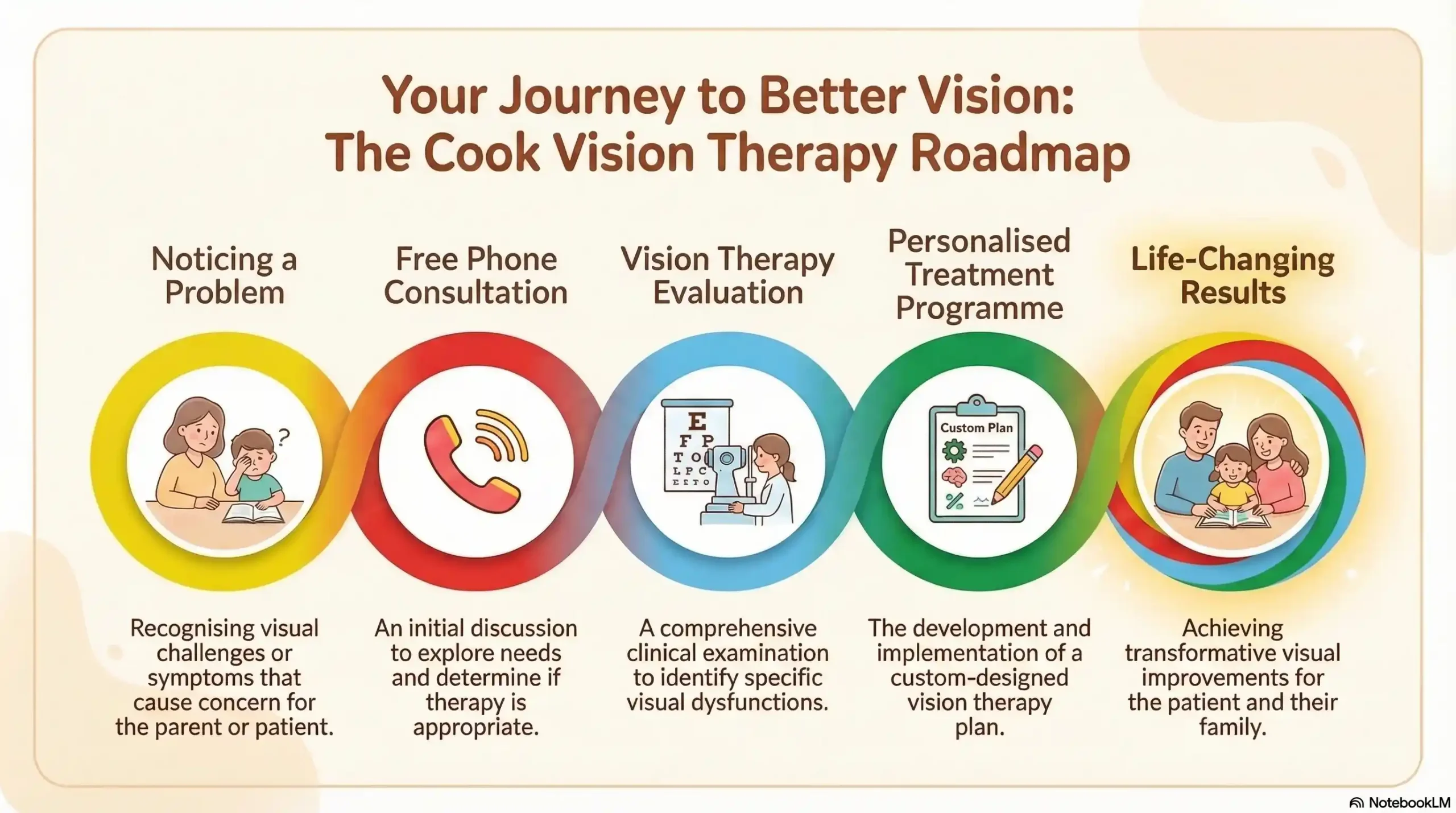
| Patient Journey Stage | What Happens | Cook Vision Advantage |
|---|---|---|
| Problem Recognition | Symptoms noticed at home or school | Detailed symptom checklist available |
| Research & Awareness | Online search for specialists | Local SEO authority + 57+ Google reviews |
| First Contact | Free phone consultation | Low-barrier, no-pressure entry point |
| Clinical Evaluation | Comprehensive Vision Therapy Evaluation | Definitive diagnosis + personalized roadmap |
| Active Treatment | In-office sessions + guided home exercises | Supervised, adaptive, collaborative program |
| Lasting Outcomes | Life-changing functional improvements | Documented results + patient advocacy |
Real Results — What Patients in Marietta and Atlanta Are Saying
The most powerful evidence for the superiority of supervised in-office vision therapy is not found in clinical literature alone — it is found in the lived experiences of patients whose lives have been genuinely transformed.
Families served by Cook Vision Therapy Center describe children whose academic performance and emotional confidence improved dramatically after therapy addressed the underlying visual root cause that had been missed by routine eye exams and misattributed to attention disorders. Parents who once watched their child struggle through every homework session report a complete reversal in both ability and attitude.
Adult patients who were told surgery was their only option for strabismus have completed Dr. Cook’s non-surgical program and achieved aligned, functional binocular vision — without a single incision. Post-TBI patients who feared they would never drive again have regained that independence through neuro-optometric rehabilitation, describing their outcomes as nothing short of life-restoring.
These are not outcomes a vision therapy app has ever documented at this level. They are the outcomes of four decades of dedicated clinical expertise, delivered one patient at a time.
📍 Visit Us or Call Today
Join the hundreds of patients across Metro Atlanta and beyond who have transformed their vision — and their lives — at Cook Vision Therapy Center.
📞 (770) 419-0400
📍 1395 South Marietta Pkwy SE, Bldg 400, Ste 107, Marietta, GA 30067
How to Choose the Right Vision Therapy Option for Your Family
Questions to Ask Before Starting Any Vision Therapy Program
Before committing to any vision therapy approach — clinical or app-based — every patient and parent deserves clear, direct answers to these foundational questions:
- Has my child or I received a comprehensive vision therapy evaluation from a COVD-certified specialist — not just a standard eye exam?
- Is the proposed program tailored to my specific diagnosis or built around a generic protocol?
- Will a licensed, certified clinician be supervising and adjusting the program as I progress?
- What documented outcomes exist for this program for my specific condition?
- Is the program appropriate for the severity of my condition?
If an app or at-home program cannot answer all five questions with clinical specificity — it is not a substitute for supervised care.
Red Flags to Watch for in App-Based Programs
Patients and parents should exercise healthy skepticism when evaluating any app-based vision therapy tool. Key red flags include: no requirement for a prior clinical diagnosis, no licensed clinician involved in program design or monitoring, testimonials that lack clinical context, and claims of treating complex conditions — strabismus, TBI, convergence insufficiency — without supervised care.
The First Step: A Comprehensive Vision Therapy Evaluation
The single most important action any patient or parent in Marietta, Cobb County, or greater Metro Atlanta can take is to begin with a comprehensive Vision Therapy Evaluation at Cook Vision Therapy Center. This evaluation provides the definitive clinical picture of what is actually affecting visual function — and, critically, what is not. It transforms uncertainty and frustration into clarity and a concrete, hopeful path forward.
🏛️ LOCAL RESOURCES & CITATIONS
1. U.S. National Institutes of Health — National Eye Institute
The federal government’s primary authority on eye health research — reference this for clinically validated information on conditions like convergence insufficiency, amblyopia, and strabismus, including published findings on the effectiveness of supervised vision therapy programs.
2. Georgia Department of Public Health — Vision Screening Program
Georgia’s official state health agency overseeing pediatric vision screening standards — parents and educators in Marietta and Cobb County can use this resource to understand state-mandated school vision screening protocols and why a clinical evaluation goes beyond what screenings detect.
3. Emory University School of Medicine — Department of Ophthalmology
A leading Atlanta-based academic medical institution whose published research and clinical education resources support the evidence base for binocular vision treatment — reinforcing the neurological and rehabilitative science that underpins supervised vision therapy programs like those offered at Cook Vision Therapy Center.
4. Cobb County School District — Student Health & Wellness
The official school district serving Marietta, Kennesaw, and surrounding communities — families can reference CCSD’s student health resources to understand how undiagnosed vision problems are frequently linked to academic performance challenges, supporting the case for a comprehensive Vision Therapy Evaluation.
Take the First Step Toward Restored Visual Performance
Vision therapy games and apps have their place in a world of expanding digital health tools. But for the conditions that are genuinely disrupting your child’s learning, your professional performance, or your recovery from neurological injury — there is no substitute for the expertise, personalization, and clinical rigor of supervised in-office vision therapy.
At Cook Vision Therapy Center, Dr. David L. Cook and his team have spent over four decades doing one thing exceptionally well: changing lives through world-class vision therapy — not just temporarily, but for the long term.
Your journey to restored visual performance begins with a single call.
🌟 Schedule Your Free Phone Consultation Today
Cook Vision Therapy Center, Inc.
📞 (770) 419-0400
📍 1395 South Marietta Pkwy SE, Bldg 400, Ste 107, Marietta, GA 30067
🌐 cookvisiontherapy.com
Serving Marietta, Kennesaw, Roswell, Midtown Atlanta, and patients across the Southeast and beyond. Distance vision therapy programs available.
Frequently Asked Questions
-
In-office therapy provides customized, doctor-supervised exercises for targeted results. Vision therapy games offer convenient, at-home practice but lack personalized professional guidance and real-time clinical adjustments.
Disclaimer:
This article is for educational purposes only and does not constitute medical advice, diagnosis, or treatment. Vision problems and symptoms should always be evaluated by a qualified eye care professional. If you or your child are experiencing vision-related difficulties, consult a licensed optometrist or vision therapy specialist for a comprehensive evaluation