Is It Really ADHD? How Vision Problems Masquerade as Attention Issues in Children

Many children diagnosed with ADHD or attention disorders may actually have an undetected functional vision problem — such as convergence insufficiency or a visual processing disorder — that makes sustained reading and focus physically uncomfortable. Unlike standard eye exams, which only test visual acuity (sharpness), a comprehensive vision therapy evaluation tests how the eyes work together, track, and process information. At Cook Vision Therapy Center in Marietta, GA, Dr. David L. Cook, O.D., F.A.A.O., F.C.O.V.D. has helped thousands of children across Metro Atlanta and the Southeast reclaim their academic confidence through personalized, non-surgical vision therapy. Call (770) 419-0400 for a Free Phone Consultation today.
The Homework Struggle Nobody Warned You About
It’s 7:30 on a Tuesday evening in Marietta. Your third-grader — the same child who can recall every detail of a dinosaur documentary, build complex LEGO structures from memory, and hold a conversation with remarkable depth — is dissolving into tears over a single page of reading homework.
You’ve tried patience. You’ve tried timers. You’ve tried reward charts. Nothing works. The school has suggested testing for ADHD. Your pediatrician has raised the possibility of attention medication. And yet, something doesn’t sit right with you — because you know this child. You know how bright they are. You know this isn’t a discipline problem or a motivation problem.
What if it isn’t an attention problem either?
What if every time your child sits down to read, their eyes are physically working against them — straining, doubling, losing focus — making the simple act of reading a page feel like trying to read while on a moving carousel? What if the frustration, the avoidance, the emotional outbursts aren’t symptoms of a behavioral disorder, but the entirely logical response of a bright child being asked to perform an impossible task with a visual system that has never been properly evaluated?
This is the reality for a significant number of children in Metro Atlanta classrooms every single day. And it is a reality that Cook Vision Therapy Center, located in Marietta, GA, has been identifying and resolving for over four decades.
What Standard Eye Exams Don’t Tell You
When most parents hear the phrase “vision problem,” they picture a child squinting at a chalkboard — a problem solved with a pair of glasses. This is a natural assumption, and it is also the reason so many functional vision disorders go undetected for years.
20/20 Vision Is Not the Whole Story
A standard school vision screening — or even a routine visit to a general optometrist — primarily evaluates one thing: visual acuity, which is simply how clearly a child can see a stationary letter on a chart at a distance of 20 feet. A child who passes this test with flying colors is sent home with a clean bill of vision health.
But visual acuity is only one component of a fully functioning visual system. A child can have perfect 20/20 acuity and still struggle profoundly with the visual demands of reading, writing, and learning — because the problem is not what their eyes see, but how their eyes work.
The Hidden Vision Skills That Affect Learning
A comprehensive functional vision evaluation assesses an entirely different set of skills — skills that are never tested in a standard exam, but that are absolutely critical to academic performance:
Eye Teaming (Binocular Vision): The ability of both eyes to work together as a coordinated team. When this system breaks down, words on a page can appear to move, blur, or double — making sustained reading physically exhausting.
Eye Tracking: The ability to move the eyes smoothly and accurately across a line of text. Poor tracking causes a child to lose their place, skip words, or re-read the same line multiple times without realizing it.
Eye Focusing (Accommodation): The ability to quickly and accurately shift focus between near and far distances — essential for copying from a whiteboard, following classroom instruction, and transitioning between tasks.
Visual Processing: The brain’s ability to accurately interpret, organize, and give meaning to what the eyes see. Weaknesses here can manifest as letter reversals, slow reading comprehension, and difficulty with spatial tasks — symptoms that are frequently and incorrectly attributed to dyslexia or learning disabilities.
When any one of these systems is not functioning efficiently, a child’s brain must work extraordinarily hard to compensate — leaving little cognitive bandwidth for comprehension, retention, or the regulated emotional responses we associate with focused, attentive learning.
The Vision-Attention Connection — What the Research Shows
The link between functional vision dysfunction and attention difficulties is not a theory — it is a clinically documented relationship that has been studied extensively in academic and optometric literature.
Convergence Insufficiency: The Most Misunderstood Condition in Classrooms
Convergence insufficiency (CI) is one of the most common and most under-diagnosed binocular vision disorders affecting school-age children. It occurs when the eyes struggle to maintain the inward turn required for near-vision tasks — specifically reading and screen work.
For a child with CI, every reading session is a physical battle. The visual system is constantly fighting to maintain a single, clear image on the page. Symptoms include:
- Headaches during or after reading
- Eyestrain and eye fatigue within minutes of beginning near work
- Words that appear to blur, double, or move on the page
- Difficulty sustaining attention on reading tasks specifically
- Avoidance of books, homework, and any prolonged near-vision activity
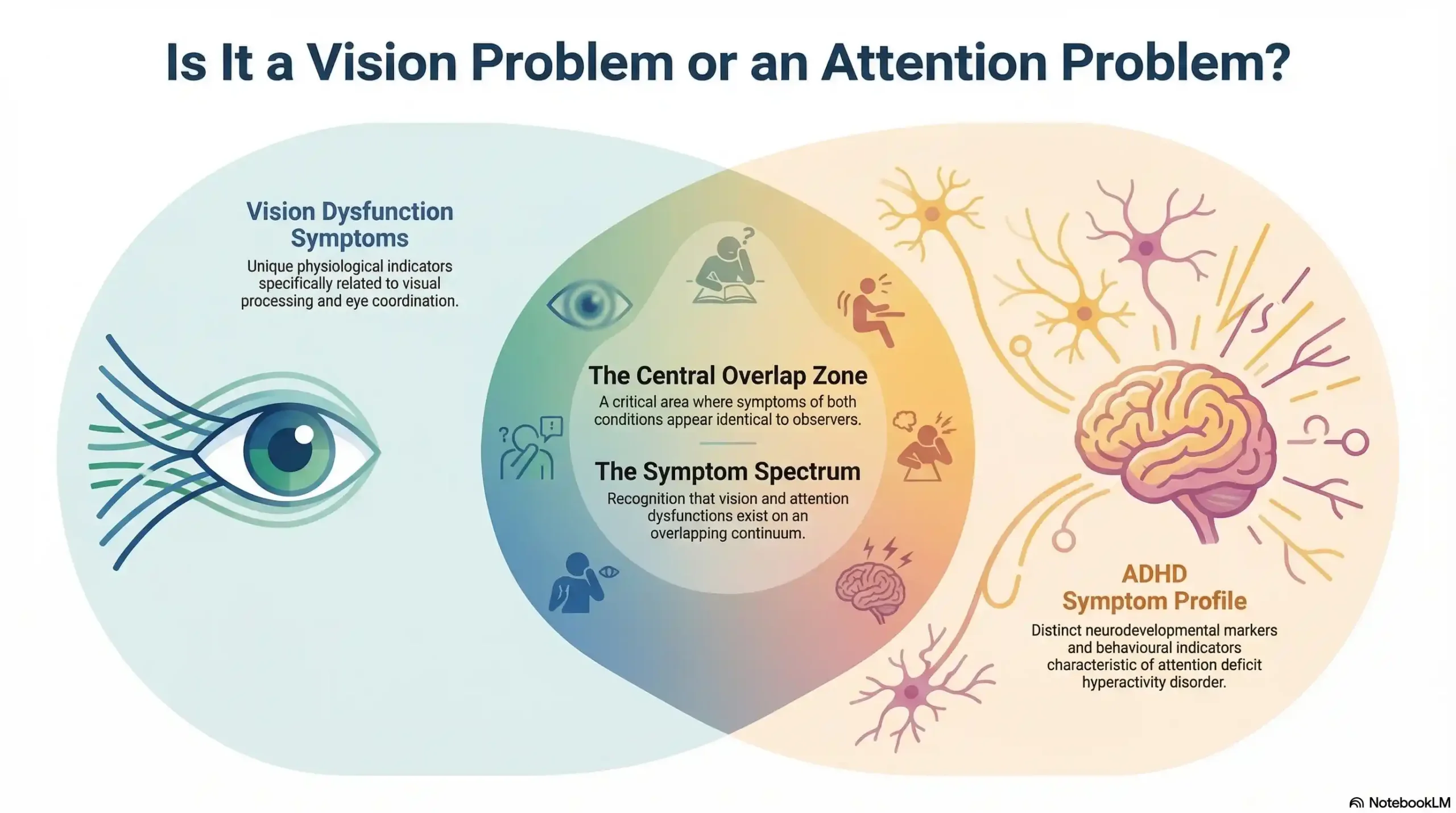
The behavioral profile of a child with undiagnosed convergence insufficiency is remarkably consistent with the diagnostic criteria for attention deficit disorder: distractibility during reading, inability to complete written tasks, frustration, avoidance behavior, and emotional dysregulation around schoolwork.
The critical distinction — one that can only be identified through a comprehensive functional vision evaluation — is that the attention difficulty is task-specific. A child with CI can focus with exceptional intensity on a video game, a hands-on project, or a verbal conversation. It is the near-vision demand of reading and writing that triggers the breakdown. This pattern is a significant clinical indicator that vision, not attention, is the root cause.
Visual Processing Disorders and Learning Struggles
Beyond the mechanical function of the eyes themselves, the brain’s processing of visual information plays a profound role in reading and learning. A visual processing disorder does not mean a child cannot see clearly — it means the brain is not efficiently interpreting the visual information it receives.
Children with visual processing weaknesses may:
- Reverse letters and numbers well beyond the age at which this is developmentally expected
- Read slowly and laboriously despite adequate phonetic instruction
- Struggle to copy accurately from the board or a book
- Have difficulty with spelling, math alignment, or spatial tasks
- Show a significant gap between their verbal intelligence and their written performance
These patterns frequently result in referrals for learning disability testing, dyslexia evaluations, or ADHD assessments — when the underlying cause is a visual processing inefficiency that is highly responsive to targeted vision therapy.
| Symptom | Vision Dysfunction | ADHD / Attention Disorder |
|---|---|---|
| Difficulty focusing during reading | ✅ Primary symptom | ✅ Common symptom |
| Strong focus during hands-on tasks | ✅ Key differentiator | ❌ Inconsistent |
| Headaches after near work | ✅ Primary symptom | ❌ Rarely reported |
| Words appear to move or double | ✅ Primary symptom | ❌ Not a feature |
| Loses place while reading | ✅ Primary symptom | ✅ Common symptom |
| Letter/number reversals | ✅ Visual processing | ✅ Sometimes present |
| Avoids reading specifically | ✅ Strong indicator | ✅ Common symptom |
| Difficulty sitting still generally | ❌ Not typical | ✅ Primary symptom |
| Responds well to vision therapy | ✅ Highly responsive | ❌ Not applicable |
Warning Signs Every Marietta Parent Should Know
If you are a parent in Marietta, Kennesaw, Roswell, or anywhere across Metro Atlanta, wondering whether your child’s struggles might have a visual root cause, the following warning signs are your most important diagnostic starting point.
At-Home Signs to Watch For
These are the behaviors most frequently reported by parents of children who are later found to have a functional vision disorder:
- Covers or closes one eye while reading or watching television
- Tilts or turns their head to an unusual angle when focusing on near work
- Loses their place frequently while reading and uses a finger to track across every line
- Skips words or entire lines without awareness
- Complains of headaches at the end of the school day or during homework
- Reports that words move, blur, or jump on the page
- Becomes highly emotional or resistant specifically around reading and written homework — but not other activities
- Reads slowly despite having strong verbal comprehension and intelligence
- Avoids books and shows reluctance to be read to or to read aloud
Signs Teachers May Report
Teachers often observe patterns in the classroom that parents do not see at home. The following reports from educators are significant red flags for functional vision dysfunction:
- Short attention span specifically during reading and writing tasks, but not during verbal discussions or hands-on activities
- Letter and word reversals beyond second grade
- Handwriting that is inconsistent, poorly spaced, or deteriorates over the course of a writing task
- A significant gap between how the child performs verbally and how they perform on written assignments
- Slow reading pace that does not respond to phonics instruction
- Frequent requests to move closer to the board or complaints about not being able to see clearly in class despite passing a vision screening
📞 Is your child showing these signs? You don’t have to keep guessing. Call Cook Vision Therapy Center today for a Free Phone Consultation at (770) 419-0400) — proudly serving Marietta, Kennesaw, Roswell, and all of Metro Atlanta. Your child’s potential is waiting to be unlocked.
How Cook Vision Therapy Center Gets to the Real Answer
A suspicion — however well-founded — is not a diagnosis. The path from concern to clarity begins with one essential step: a comprehensive Vision Therapy Evaluation at Cook Vision Therapy Center.
The Vision Therapy Evaluation — Your Definitive Starting Point
Unlike the brief screenings performed at schools or during routine optometry appointments, the Vision Therapy Evaluation at Cook Vision Therapy Center is an in-depth clinical assessment designed to test every dimension of the functional visual system.
The evaluation examines:
- Binocular vision function — how effectively the eyes work as a coordinated team
- Convergence and divergence ability — the eyes’ capacity to turn in and out for near and far tasks
- Ocular motility — the accuracy and smoothness of eye movements across a page
- Accommodative function — the speed and accuracy of focus changes
- Visual processing skills — how the brain interprets, retains, and acts on visual information
- Spatial awareness and eye-body coordination
The outcome of this evaluation is not simply a diagnosis — it is a clear, personalized roadmap. Parents leave understanding exactly what is affecting their child’s visual performance, why it has been producing the symptoms they’ve observed, and what a targeted, structured vision therapy program will do to correct it.
Meet Dr. David L. Cook, O.D., F.A.A.O., F.C.O.V.D.
When families across Metro Atlanta — and across the country — are searching for definitive answers to their child’s learning struggles, they arrive at the office of Dr. David L. Cook, O.D., F.A.A.O., F.C.O.V.D.
Dr. Cook is an internationally recognized clinician, educator, and published author with over forty years of experience diagnosing and treating the full spectrum of functional vision disorders in children and adults. His published works — including Visual Fitness and When Your Child Struggles — have guided both parents and practitioners in understanding the profound connection between vision and learning. Dr. Cook has treated thousands of patients from across the Southeast and beyond, establishing Cook Vision Therapy Center as one of the most respected vision therapy practices in the nation.
Families travel from Chattanooga, Birmingham, Charleston, and across the country to access the level of care available right here in Marietta, GA — because when the stakes are high, expertise matters.

| Stage | Phase | What Happens |
|---|---|---|
| Stage 1 | Awareness | Parent or patient recognizes persistent struggle unresolved by standard solutions |
| Stage 2 | Research | Discovery of Cook Vision Therapy Center via search, referral, or reviews |
| Stage 3 | Free Phone Consultation | Low-barrier first contact — concerns heard, questions answered, no pressure |
| Stage 4 | Vision Therapy Evaluation | Comprehensive functional assessment — definitive diagnosis and personalized plan |
| Stage 5 | Treatment & Advocacy | Structured in-office and at-home therapy program → life-changing results → patient becomes advocate |
What Vision Therapy Actually Does — And Why It Works
Understanding that a vision problem exists is only the beginning. The natural next question for every parent is: what exactly does vision therapy involve, and does it actually work?
Retraining the Visual System, Not Just Correcting Eyesight
Vision therapy at Cook Vision Therapy Center is a structured, medically supervised program of individualized exercises and activities designed to retrain the visual system at a neurological level. Unlike corrective lenses, which compensate for visual deficiencies, vision therapy corrects the underlying dysfunction — building the visual skills that were never properly developed.
Sessions take place in-office with a trained vision therapist using specialized equipment, and are reinforced by targeted at-home exercises between appointments. This combination of professional guidance and patient participation — what one Cook Vision patient described as “gotta do your homework!” — is what produces lasting, structural improvements rather than temporary symptom relief.
Treatment timelines are personalized to each patient’s specific profile and goals, but most programs range from several months to approximately one year. Progress is monitored throughout, and therapy plans are adjusted as visual skills develop.
Real Results for Marietta Families
The measure of any clinical program is its outcomes. At Cook Vision Therapy Center, the outcomes speak with remarkable consistency:
Children who once dreaded opening a book are reading independently and with confidence. Students whose teachers were recommending ADHD evaluations are performing at grade level and above. Families who arrived frustrated, exhausted, and out of options are leaving with a child whose self-esteem — and whose future — has been genuinely transformed.
This is not accidental. It is the result of forty years of clinical excellence, a deeply personalized approach to care, and an unwavering commitment to the belief that every child deserves to have the true root cause of their struggle identified and resolved — not simply managed.
📍 Ready to find the real answer for your child? Schedule a comprehensive Vision Therapy Evaluation at Cook Vision Therapy Center today. 1395 South Marietta Pkwy SE, Bldg 400, Ste 107, Marietta, GA 30067 📞 (770) 419-0400 | cookvisiontherapy.com
Serving Marietta, Metro Atlanta, and Beyond
Cook Vision Therapy Center is located in Marietta, GA, at the heart of Metro Atlanta’s Cobb County — making it conveniently accessible to families throughout the region, including Kennesaw, Roswell, Smyrna, Vinings, Midtown Atlanta, and Duluth.
The clinic’s reputation for clinical excellence has cultivated a patient base that extends far beyond its immediate geography. Patients travel regularly from Chattanooga, Birmingham, and Charleston to access Dr. Cook’s expertise. For those unable to attend in person on an ongoing basis, Cook Vision Therapy Center offers personalized Distance Vision Therapy Programs — allowing patients who complete an initial in-person evaluation to continue their therapy from home, wherever in the country they may be.
Whether you are a Marietta family seeking answers for a struggling second-grader, a Roswell professional experiencing chronic convergence-related eyestrain, or a patient traveling from across the Southeast in search of a true specialist — Cook Vision Therapy Center is the practice built for you.
🏛️ Local Resources & Citations
1. Georgia Department of Education — Student Health & Vision Requirements. The official state authority on vision screening mandates and special education eligibility in Georgia public schools — cite this to validate why a school screening is insufficient and a full functional evaluation matters.
2. Cobb County School District — Special Education & Student Support Services The local school district serving Marietta families, Kennesaw, and Smyrna — reference this to ground the article in the exact educational environment your patients navigate daily, reinforcing local relevance for Google Maps ranking.
3. National Eye Institute (NEI) — Convergence Insufficiency Research A .gov research authority under the NIH that publishes peer-reviewed clinical findings on convergence insufficiency and its impact on reading and attention — the single strongest citation available for YMYL credibility on this topic.
4. Georgia Optometric Association The official professional body governing optometric standards and patient care guidelines in Georgia — citing this establishes that Cook Vision Therapy Center operates within a regulated, credentialed professional framework, building additional trust with both patients and Google’s quality raters.
Take the First Step Toward Clarity
Your child is not struggling because of who they are.
They are not lazy, unfocused, or incapable. They may simply be navigating a world of text and near-vision demands with a visual system that has never been properly evaluated — and never been allowed to perform the way it is capable of performing.
A comprehensive Vision Therapy Evaluation at Cook Vision Therapy Center could be the single most important appointment you schedule this year. Not because it will necessarily provide every answer, but because it will provide the answer that no one else has looked for yet.
Dr. Cook and the team at Cook Vision Therapy Center have dedicated over four decades to doing exactly that: finding the real answer, building a personalized path forward, and changing the lives of children and families across Metro Atlanta and beyond — not temporarily, but for the long term.
The first step is a conversation.
📞 Don’t wait for another difficult school year. Contact Cook Vision Therapy Center today for a Free Phone Consultation. Call (770) 419-0400 or visit cookvisiontherapy.com to take the first step toward your child’s clearest, most confident future. Cook Vision Therapy Center — Marietta, GA Changing Lives, One Patient at a Time.
Frequently Asked Questions
-
Binocular Vision Dysfunction (BVD) and Convergence Insufficiency are frequently misdiagnosed as ADHD. Both conditions cause severe eye strain, making it difficult to maintain focus and attention during reading tasks.