Vertical Heterophoria: Why Your MRI Is Normal But You Feel Dizzy
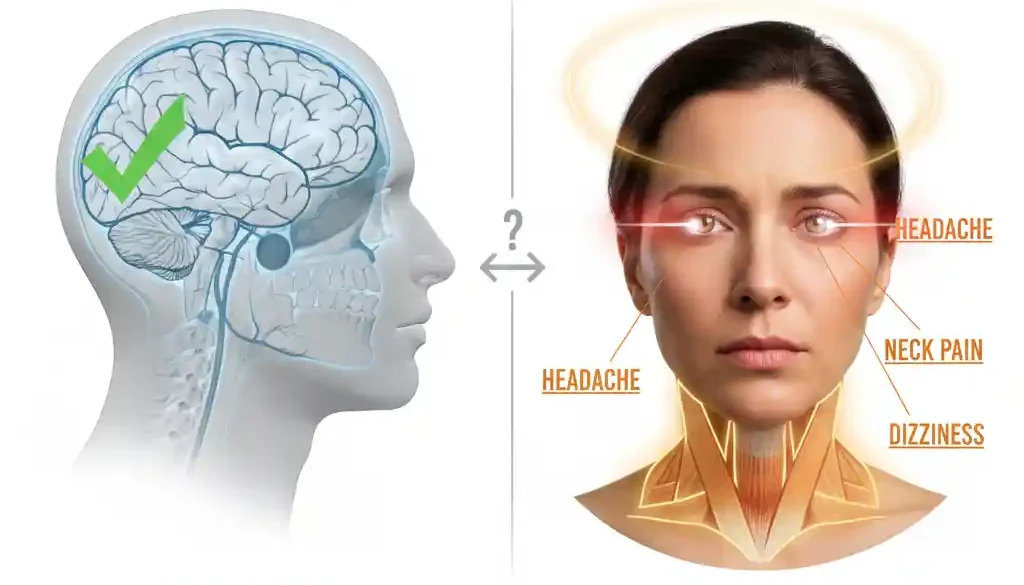
Vertical Heterophoria (VH) is a subtle eye misalignment that often causes unexplained headaches, dizziness, and anxiety, even when standard eye exams and MRIs appear “normal.” At Cook Vision Therapy Center in Marietta, we specialize in neuro-optometric rehabilitation to bridge this functional vision gap and provide long-term relief without relying solely on compensatory lenses.
[Take the Functional Vision Self-Screener]
The “Normal Test” Paradox: Why Structural Health Isn’t Functional Comfort
Many patients arrive at our Marietta clinic after a frustrating cycle of clear MRIs and ENT reports. The reason these tests fail to provide answers is simple: they are designed to find disease, not misalignment.
-
Structural Health: An MRI confirms your brain and optic nerves are physically intact.
-
Functional Comfort: This is how your eyes work together as a team.
In Vertical Heterophoria (VH), one eye is physically positioned just a few millimeters higher than the other. Because the brain cannot tolerate double vision, it forces your extraocular muscles to constantly “tug” the eyes into alignment. You don’t see the misalignment, but you feel the exhaustion it creates.
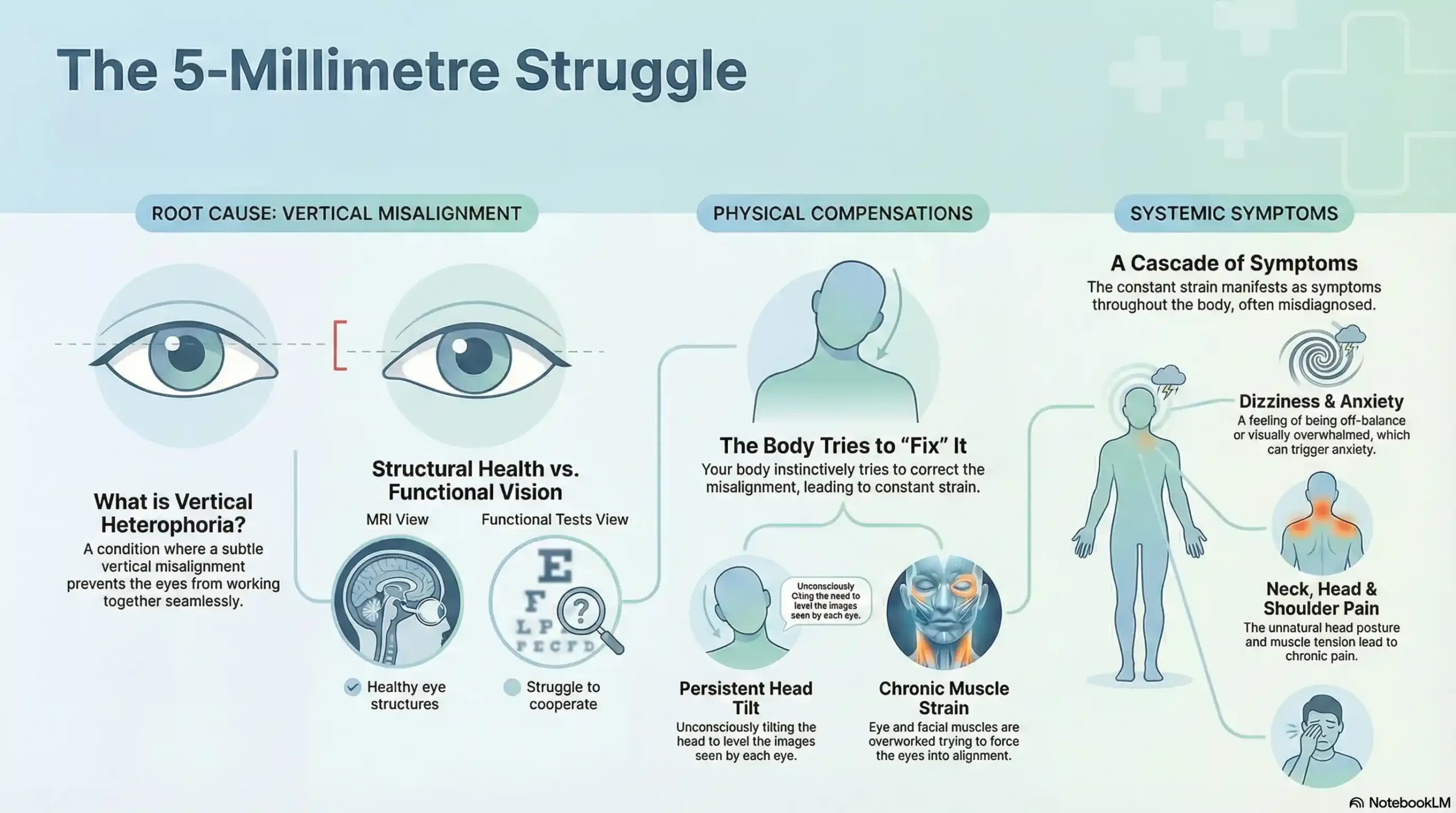
The “5-Millimeter Struggle”: Tracking the Cause and Effect
Your eye muscles are among the hardest-working muscles in your body. When they are locked in a 24/7 struggle to overcome a vertical gap, the strain radiates outward.
-
Muscle Fatigue: Leads to a heavy, dull ache behind the eyes or at the brow line.
-
Postural Compensation: You may unconsciously tilt your head toward one shoulder to help level your vision.
-
Chronic Pain: This constant tilt causes localized neck and shoulder tension, often misdiagnosed as “tech neck.”
-
Vestibular Confusion: Because the eyes and inner ears provide conflicting data about the horizon, you experience dizziness or a sense of being “off-balance.”
Decision Logic: Prism Lenses vs. Neuro-Optometric Vision Therapy
When considering treatment, it is helpful to understand the “Repair vs. Support” logic. Both have a place in recovery, but they serve different long-term goals.
The Support Method: Prism Glasses
Prism lenses bend light before it hits your eye, effectively “moving” the image so your eye can stay in its comfortable, misaligned position.
-
Best for: Immediate relief and stabilizing patients with severe vertigo.
-
Limitation: It is a compensatory tool; it does not change how your brain processes visual information.
The Repair Method: Vision Therapy
This is a personalized program of neuro-optometric rehabilitation. Instead of just “propping up” the eyes with a lens, we use targeted exercises to retrain the neurological pathways.
-
The Goal: Building the “visual stamina” required to maintain alignment naturally.
-
The Outcome: Long-term independence from heavy prescriptions and a reduction in visual “overload.”
Local Triggers: Navigating I-75 and the 120 Loop
For a person with VH, the Marietta environment provides unique challenges. Driving on high-speed stretches of I-75 or navigating the 120 Loop requires rapid visual processing.
When cars zip past your peripheral vision, a misaligned visual system can “short-circuit,” leading to sudden dizziness or a feeling that you are veering out of your lane. Understanding these triggers is the first step toward [reclaiming your confidence behind the wheel].
Impact on Learning: From the Classroom to the Marietta Library
Vertical Heterophoria is frequently mislabeled in children as ADHD. If a student at a Cobb County school struggles to stay on a line while reading, or experiences “brain fog” after ten minutes of homework, it is often because their eyes are physically fighting the page.
-
Signs to watch for: Closing one eye while reading, frequent rubbing of the temples, or avoiding near-work.
-
The Decision: Addressing the visual root cause often resolves the behavioral “fidgeting” that occurs when a child is visually exhausted.
Local Resources
-
Georgia Department of Driver Services (DDS): Official vision requirements for maintaining a legal license in Georgia.
-
Cobb County School District (CCSD): Information on mandatory vision screenings and Form 3300 for local students.
What to Expect During a Specialized Evaluation
A standard 20/20 vision screening will miss Vertical Heterophoria nearly 100% of the time. At Cook Vision Therapy Center, our diagnostic process is different:
-
Duration: We spend significant time measuring “micro-deviations” in your vertical alignment.
-
Prism Trialing: We often let you “wear” a temporary prism in the office to see if your symptoms diminish immediately.
-
Honest Assessment: We will tell you if your case is best suited for glasses, therapy, or a combination of both.
If you are tired of managing symptoms and want to understand the mechanical cause of your discomfort, requesting a comprehensive neuro-optometric functional exam is the most direct path to clarity.
FAQs
-
Vertical Heterophoria is a tiny vertical misalignment of the eyes. Your brain forces eye muscles to overwork to fix the offset, leading to “visual dizziness,” lightheadedness, and a persistent “off-balance” feeling.